
Solid shapes are one of the first big ideas that introduce children to the world beyond flat paper and into real, touchable objects. Every ball, box, cone-shaped ice cream, or tin can that a child picks up is a live example of a solid shape in action. But what are solid shapes, exactly? In simple terms, they are three-dimensional (3D) figures that take up space and have volume, unlike flat, two-dimensional shapes that exist only on paper.
Understanding the difference between flat and solid shapes is one of the earliest geometry skills a learner develops, and it lays the foundation for everything from basic shape recognition to advanced spatial reasoning later on. This guide breaks down the types, properties, and teaching strategies for solid shapes in a simple, practical way useful for parents, teachers, and curious students alike.
Types of Solid Shapes
Solid shapes are generally divided into two broad families based on the kind of surfaces they have: shapes made of flat faces and shapes made of curved surfaces. Recognizing this split makes it much easier to classify solid shapes examples encountered in everyday life, from a cereal box to a football.
Polyhedra (Solid Shapes with Flat Faces)
A polyhedron is any solid figure built entirely from flat, polygon-shaped faces joined by straight edges and sharp corners called vertices. These shapes are usually sorted by how many faces they have and how those faces are arranged. Two of the most common groups are prisms and pyramids.
A prism is made of two identical, parallel bases connected by rectangular side faces a rectangular prism (like a brick) and a triangular prism (like a tent) are the most familiar examples children encounter. A pyramid, on the other hand, has just one base, with every other face being a triangle that rises up to meet at a single apex. Square pyramids and triangular pyramids (also called tetrahedrons) are the go-to classroom examples for this category.
Read More: WBU Meaning: The Real Answer Behind Those Three Letters
Non-Polyhedra (Solid Shapes with Curved Surfaces)
Not every solid shape is built from flat panels. Some, known as non-polyhedra, include at least one curved surface instead of straight edges. This group includes:
- A cylinder, which has two parallel circular bases joined by a smooth, curved surface think of a soda can.
- A cone, featuring one circular base and a curved surface that narrows to a single point, like an ice cream cone.
- A sphere, a perfectly round solid with no flat faces, no edges, and no vertices at all a basketball is a classic real-world example.
Why Understanding Solid Shapes Is Important
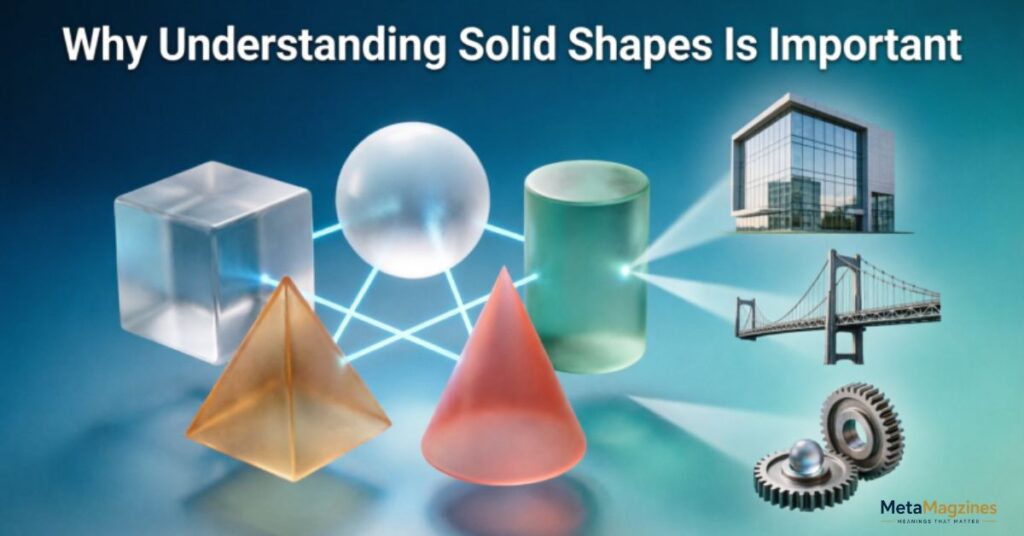
Learning about solid shapes isn’t just a geometry checkbox it builds real cognitive skills that carry over into science, engineering, art, and everyday problem-solving.
Developing Spatial Awareness & Visualization
Working with solid shapes teaches students how objects occupy physical space and how different objects relate to one another in that space. This kind of spatial reasoning is essential not only in geometry class but also in fields like architecture, robotics, and even everyday tasks such as packing a suitcase or arranging furniture. The earlier this skill is nurtured, the more naturally it develops.
Connecting 2D Shape and Solid Shape Concepts
A strong grasp of solid shapes builds directly on what students already know about flat, two-dimensional shapes. It shows learners how simple flat figures combine to create three-dimensional objects for instance, a cube is formed from six identical square faces, while a cylinder relies on two circular bases plus one curved side.
Exploring nets flat, foldable layouts that assemble into solid figures is one of the most effective ways to reinforce this link. Nets visually “unfold” a 3D object into its 2D components, helping students see exactly how dimensions interact. This groundwork later supports more advanced topics such as surface area, volume, and cross-sections.
Teaching Strategies for Solid Shapes
Effective teaching of solid shapes combines hands-on exploration, visual documentation, and guided reasoning, rather than relying on memorization alone.
Sorting and Comparing Solid Shapes
Start by giving students physical models, building blocks, or everyday objects, and let them explore how each shape feels, rolls, or stacks. Ask open questions like “Which shapes roll?” or “Which ones stack neatly?” As students sort shapes by observable traits number of faces, edges, and vertices, or whether the surface is flat or curved have them log their observations in a simple comparison chart. This blend of physical handling and visual recording turns abstract properties into something concrete and memorable.
Connecting Solid Shapes to Their 2D Components
Once students can confidently identify and sort solids, the next step is linking each 3D shape back to its flat components. Have them trace the faces of solid objects onto paper and name the resulting 2D shapes. Introducing nets at this stage and letting students fold pre-cut nets into solids helps confirm or correct their predictions.
Encouraging students to draw and cut their own nets, then troubleshoot when a fold doesn’t work, keeps the learning cycle active and self-correcting. Viewing solids from different angles (front, side, top) further sharpens their understanding of perspective.
Reasoning About Properties of Solid Shapes
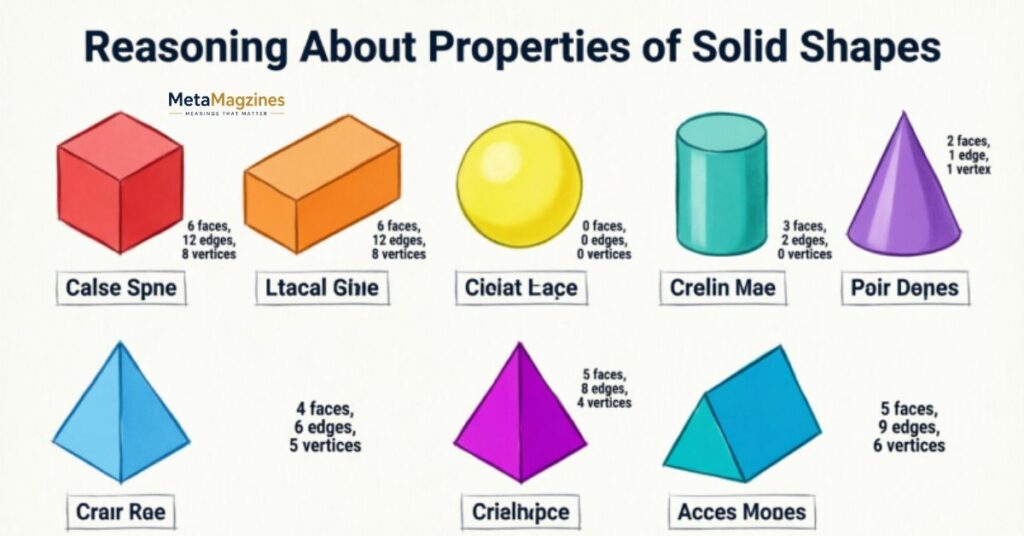
As confidence grows, challenge students with reasoning-based questions rather than simple identification tasks. Ask things like, “If you could see only one face of a shape, could you guess what it is?” or present property-based riddles such as, “I have two circular faces and one curved surface what am I?” These questions push students to compare shapes, notice patterns, and understand that correctly classifying a solid requires looking at multiple properties together, not just one.
10 Solid Shapes You Should Know
For quick reference, here are ten common solid shapes examples every student should be able to name and describe: cube, cuboid (rectangular prism), sphere, cylinder, cone, square pyramid, triangular pyramid (tetrahedron), triangular prism, hexagonal prism, and octahedron. Each of these appears constantly in daily life from dice and boxes to traffic cones and gift-wrapped pyramids making them ideal starting points for classroom demonstrations.
Solid Shapes and Their Properties
Every solid shape can be described using three key properties: faces, edges, and vertices. A face is a flat or curved surface, an edge is where two faces meet, and a vertex is the point where edges intersect. For example, a cube has 6 faces, 12 edges, and 8 vertices, while a sphere has no edges or vertices at all since its entire surface is curved. Comparing these properties across different shapes is one of the fastest ways to build lasting geometric understanding.
Solid Shapes for Class 1 and Class 2 Students
For younger learners, solid shapes for Class 2 and Class 1 are usually introduced through play rather than formal definitions. Simple activities sorting toy blocks, identifying shapes in the classroom, or matching real objects like balls and boxes to their shape names work far better than textbook diagrams alone at this stage. Keeping vocabulary simple (round, flat, pointy, curved) helps young students build intuition before formal terms like “vertex” or “edge” are introduced.
Flat and Solid Shapes: What’s the Difference?
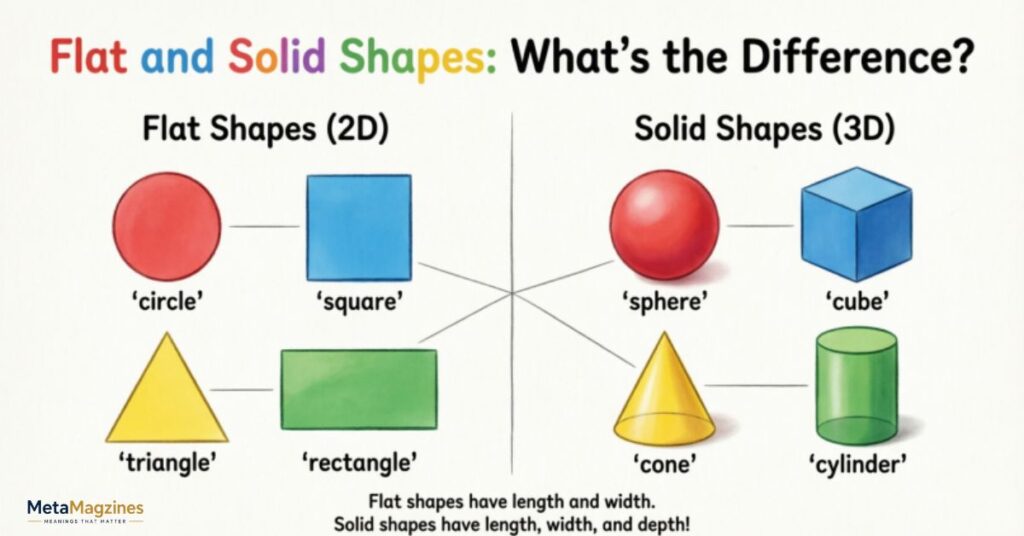
The core difference between flat and solid shapes comes down to dimensions. Flat shapes, such as circles, squares, and triangles, exist on a two-dimensional plane and have only length and width. Solid shapes add a third dimension height or depth giving them volume and the ability to occupy physical space. A simple classroom trick is comparing a paper square to a wooden cube: both share the same basic outline, but only the cube can be picked up, stacked, or filled.
Solid Shapes in Mathematics: PDFs and Worksheets for Practice
For extra practice beyond the classroom, printable solid shapes in mathematics pdf worksheets are a popular resource for both teachers and parents. These typically include shape-matching exercises, net-folding templates, and property-comparison charts that reinforce everything covered above. Using solid shapes in mathematics worksheets alongside hands-on activities gives students a well-rounded mix of tactile and written practice, which tends to improve retention far more than either method alone.
Frequently Asked Questions
Can you give me 10 examples of solid shapes?
Cube, cuboid, sphere, cylinder, cone, square pyramid, triangular pyramid, triangular prism, hexagonal prism, and octahedron are ten common examples.
How do you explain solid shapes to kids?
Use real objects like balls, boxes, and cones, and let kids touch, stack, and roll them to feel the difference in shape and structure.
What are solid shapes for class 1?
At this level, solid shapes are introduced through simple, everyday objects like balls, boxes, and cans, focusing on basic recognition rather than formal properties.
What are solid shapes also known as?
They are also called three-dimensional shapes, 3D shapes, or solid figures.
What is a solid shape in math?
A solid shape is a three-dimensional figure that occupies space and has measurable volume, unlike flat, two-dimensional shapes.
Conclusion
Solid shapes form one of the most practical and visual branches of early mathematics, connecting abstract geometry to objects students already know from daily life. From flat-faced polyhedra like cubes and pyramids to curved non-polyhedra like spheres and cones, each shape carries its own set of properties worth exploring through faces, edges, and vertices. Understanding the relationship between flat and solid shapes builds a bridge from basic 2D recognition to full 3D spatial reasoning, a skill that supports future learning in geometry, science, and design.
Whether through hands-on sorting activities, printable worksheets, or guided reasoning questions, teaching solid shapes works best when concrete exploration and critical thinking go hand in hand. With consistent practice, students move from simply naming shapes to genuinely understanding how the physical world around them is built, one face, edge, and vertex at a time.

