
Finding the right tool is easier when you know both its name and its job. This guide to Tools That Start With B brings together familiar workshop gear, automotive equipment, construction implements, measuring instruments, power tools, trade equipment, industrial machines, safety gear, and digital products in one practical reference.
The goal is not simply to create a long vocabulary list. Each entry explains what the item does, where it is useful, and what a user should consider before putting it to work. The result is a useful starting point for homeowners, mechanics, builders, carpenters, machinists, DIY enthusiasts, and professionals.
Quick List: Common Tools That Start With B
Tools That Start With B are easiest to scan when the quick list puts familiar names before specialized entries.
- Ball-peen hammer
- Bandsaw
- Bar clamp
- Belt sander
- Bench vise
- Bolt cutter
- Box cutter
- Brad nailer
- Brick hammer
- Brace
- Bubble level
- Buffer
- Burr tool
- Bushing driver
- Bradawl
- Breaker bar
- Bearing puller
- Bevel gauge
- Bench grinder
- Biscuit joiner
Basic Hand Tools That Start With B
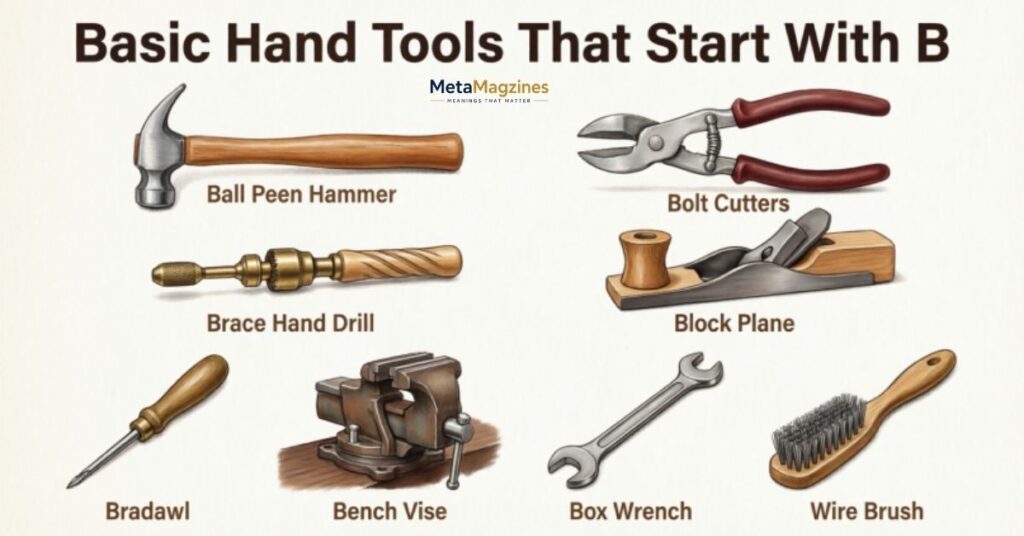
Tools That Start With B include many hand tools that remain useful even when a workshop also has modern power equipment.
Ball-Peen Hammer
Type: Hand tool — Striking. A ball-peen hammer has a flat face for ordinary blows and a rounded peen for shaping metal, peening rivets, and light fabrication work. Its usefulness comes from having two distinct striking surfaces in one compact tool.
Box-End Wrench
Type: Hand tool — Fastening. A box-end wrench surrounds a fastener rather than gripping only two exposed sides. The enclosed profile can reduce slipping and is especially helpful when a bolt needs controlled turning in a confined space.
Brace
Type: Hand tool — Drilling. A brace is a manually powered drill with a crank-like handle and chuck. It offers slow, deliberate cutting and strong control, making it valuable for traditional woodworking and situations where electricity is unavailable.
Brad Awl
Type: Hand tool — Piercing. A brad awl makes small starter holes in wood before a nail or screw is driven. Creating that pilot point can reduce wandering and lower the chance of splitting narrow stock.
Bradawl
Type: Hand tool — Marking. A bradawl is a pointed hand tool used to mark and pierce small holes in timber and other soft materials. It is particularly convenient for establishing an accurate starting point before drilling.
Burnisher
Type: Hand tool — Finishing. A burnisher uses a hard, smooth surface to compress or polish material. Woodworkers can use one to refine a scraper edge, while metalworkers may use related burnishing methods to improve a surface.
Bar Clamp
Type: Hand tool — Clamping. A bar clamp uses a long rail with an adjustable jaw to hold wide workpieces. It is useful during glue-ups, panel assembly, cabinet work, and other jobs where stable pressure matters.
Bench Plane
Type: Hand tool — Shaping. A bench plane removes thin shavings from wood to flatten, straighten, and smooth a surface. The blade depth and the condition of the sole strongly influence the quality of the finished cut.
Block Plane
Type: Hand tool — Trimming. A block plane is compact enough for one-handed work and is commonly used on end grain, small edges, chamfers, and fitting operations. It is a practical choice when a large plane feels excessive.
Bevel Gauge
Type: Hand tool — Measuring. A bevel gauge transfers an existing angle from one workpiece to another. It is useful for repeatable layout because the blade can be locked once the desired angle has been established.
Box Cutter
Type: Hand tool — Cutting. A box cutter uses a replaceable utility blade to open packaging, trim cardboard, score sheet materials, and handle light cutting duties. A retractable or guarded design helps reduce accidental contact with the blade.
Bench Hook
Type: Hand tool — Workholding. A bench hook sits against the edge of a workbench and gives a board a firm reference while it is being sawn. It is simple, inexpensive, and especially useful for controlled hand-cutting.
Bolster Chisel
Type: Hand tool — Masonry cutting. A bolster chisel has a broad cutting edge designed for brick, stone, and mortar. It is normally struck with a hammer and should be paired with suitable eye protection because masonry work can create flying fragments.
Brick Bolster
Type: Hand tool — Masonry. A brick bolster is a wide-edged chisel intended for controlled splitting and trimming of brick or block. The broader blade helps distribute the impact along a scored line.
Bat (Mason’s)
Type: Hand tool — Masonry. A mason’s bat is a partial brick or specially prepared piece used to complete patterns and fill spaces in brickwork. It helps a mason handle dimensions that do not require a full brick.
Bench Vise
Tools That Start With B are not all small or portable; a bench vise is a fixed workholding solution for many repair and fabrication tasks.
Type: Hand tool — Workholding. A bench vise clamps a workpiece securely to a fixed surface. It is useful for filing, sawing, drilling, bending, assembly, and repair because both hands remain available for the job.
Bolt Cutter
Tools That Start With B can include high-leverage cutters, but a bolt cutter should only be used within its rated capacity and intended material.
Type: Hand tool — Cutting. Bolt cutters use long handles and compound leverage to cut suitable rods, chains, bolts, and wire. Jaw design and cutting capacity must match the material; forcing a tool beyond its rating can damage the jaws.
Burr Tool
Type: Hand tool — Shaping. A burr tool or deburring hand tool removes sharp edges left after drilling, cutting, or machining. It is a small finishing aid, but it can make parts safer to handle and easier to assemble.
Mechanic Tools That Start With B
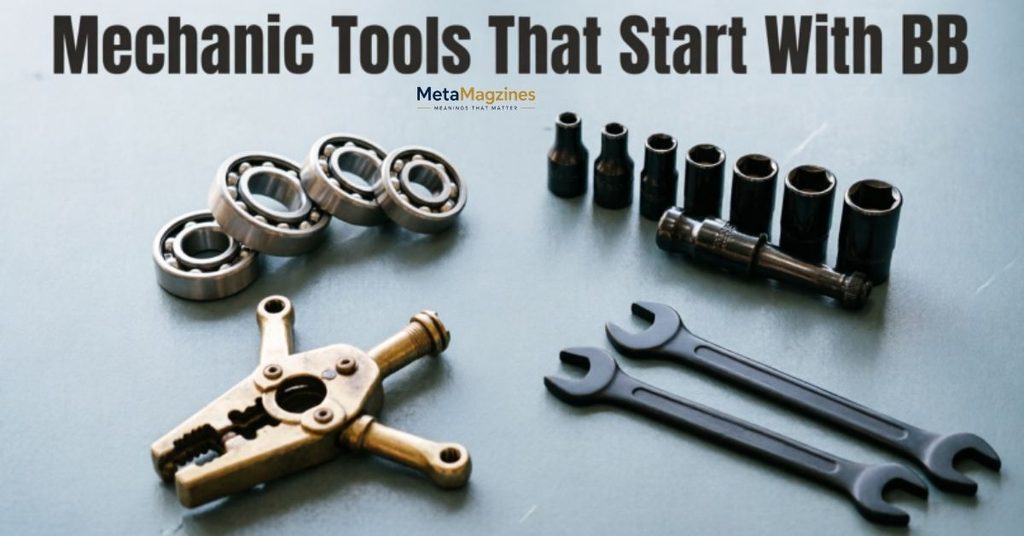
Tools That Start With B are particularly varied in automotive work, where one letter covers removal, measurement, electrical testing, and installation.
Breaker Bar
Type: Mechanic tool — Loosening. A breaker bar is a long-handled socket tool designed to provide more leverage than a short ratchet. It is useful for loosening stubborn fasteners, but it should not be treated as a torque-measuring device.
Bearing Puller
Type: Mechanic tool — Removal. A bearing puller grips a bearing and applies controlled pulling force so the component can be removed from a shaft or housing. Selecting the correct jaw arrangement helps prevent damage to nearby parts.
Brake Caliper Tool
Type: Mechanic tool — Brake service. This tool retracts or winds a brake caliper piston when replacing pads. The required mechanism varies by vehicle, so the tool must suit the caliper design rather than being chosen only by appearance.
Ball Joint Press
Type: Mechanic tool — Suspension service. A ball joint press applies substantial force to remove or install press-fit joints. It is commonly used with adapters that match the diameter and shape of the components being serviced.
Brake Bleeder Kit
Type: Mechanic tool — Brake service. A brake bleeder kit helps remove trapped air and old fluid from a hydraulic brake system. Vacuum, pressure, and manual versions work differently, but all require careful fluid handling and correct bleeding procedure.
Belt Tension Gauge
Type: Mechanic tool — Measurement. A belt tension gauge checks whether a drive belt is within its intended tension range. Correct tension helps prevent slipping, excessive vibration, and unnecessary wear on related components.
Bearing Race Driver Set
Type: Mechanic tool — Installation. A bearing race driver set provides interchangeable discs for seating races without striking the wrong surface. Matching the driver diameter to the race reduces the risk of distortion or housing damage.
Bore Gauge
Type: Mechanic tool — Measurement. A bore gauge measures internal diameters and can reveal taper or out-of-round conditions. It is valuable during engine rebuilding because a single diameter reading may not describe the whole cylinder accurately.
Battery Terminal Puller
Type: Mechanic tool — Electrical service. A battery terminal puller separates a stubborn terminal from a battery post with controlled mechanical force. It is safer for the connection than levering aggressively with a screwdriver or pry tool.
Battery Load Tester
Type: Mechanic tool — Electrical testing. A battery load tester checks how a battery behaves when a significant electrical load is applied. This can reveal weakness that a simple open-circuit voltage reading may not expose.
Bushing Driver Set
Type: Mechanic tool — Installation. A bushing driver set uses sized adapters to press bushings into suspension, steering, or drivetrain components. Correct alignment is important because a crooked installation can shorten component life.
Brake Drum Puller
Type: Mechanic tool — Removal. A brake drum puller applies force to a stubborn drum while keeping the pulling action controlled. It can be helpful when corrosion or wear has made ordinary removal difficult.
Ball Hone
Type: Mechanic tool — Engine preparation. A ball hone has flexible abrasive balls that lightly condition a cylinder wall. It is commonly used to create a suitable surface pattern for ring seating after the bore has been properly prepared.
Brake Line Bender
Tools That Start With B can solve specialized maintenance problems, and a brake line bender is a good example of a tool designed for controlled forming.
Type: Mechanic tool — Tubing forming. A brake line bender creates controlled curves in tubing without the sharp kinks that can restrict flow or weaken the line. A clean bend is important for both fit and serviceability.
Battery Brush
Type: Mechanic tool — Cleaning. A battery brush removes corrosion and residue from battery posts and terminals. Keeping contact surfaces clean can improve electrical connection, although damaged terminals still require proper replacement rather than repeated cleaning.
Read More: 113+ Tools That Start With C: Hand, Power, Mechanic & Construction Tools
Ball Joint Separator
Type: Mechanic tool — Suspension separation. A ball joint separator helps separate a tapered joint during service. Different designs use impact, screw force, or fork action, and the choice should reflect whether component preservation is important.
Construction Tools That Start With B
Tools That Start With B also include practical construction equipment for masonry, concrete, drywall, layout, and demolition.
Brick Hammer
Type: Construction tool — Masonry. A brick hammer combines a striking face with a shaped edge for trimming and splitting masonry. Its balance lets a mason make controlled adjustments without reaching for two different tools.
Bull Float
Type: Construction tool — Concrete finishing. A bull float has a wide blade mounted on a long handle and is used to smooth freshly placed concrete. The operator can work from outside the slab area while covering a broad surface.
Block Splitter
Type: Construction tool — Paving. A block splitter uses mechanical force to separate concrete blocks or pavers along a controlled line. It can be useful where a clean split is preferred over a dusty saw cut.
Boning Rod
Type: Construction tool — Leveling. Boning rods are used as visual references for establishing consistent levels and grades. They are especially useful in groundwork, drainage preparation, and other layout tasks where a long run must remain uniform.
Building Line
Type: Construction tool — Alignment. A building line is stretched tightly between reference points to create a straight guide. Bricklayers use it to keep courses aligned and maintain a consistent face.
Bar (Crowbar)
Type: Construction tool — Prying. A crowbar is a steel lever used for lifting, separating, pulling, and demolition tasks. Its leverage depends on the length of the bar and the position of the fulcrum, so users should avoid unstable setups.
Bolt Gun (Powder-Actuated)
Type: Construction tool — Fastening. A powder-actuated fastening tool uses a controlled cartridge to drive compatible fasteners into approved substrates. These devices require training, protective equipment, and strict adherence to manufacturer and site rules.
Battering Ram

Type: Construction tool — Demolition. A battering ram is a heavy impact device intended for breaking through substantial barriers. Modern demolition work more often relies on powered breakers and excavator attachments, but the term remains recognizable for heavy-impact equipment.
Brick Trowel
Type: Construction tool — Masonry. A brick trowel spreads and shapes mortar during bricklaying. The blade profile and handle balance affect how easily a mason can pick up, place, and trim mortar.
Board Stretcher (Drywall)
Type: Construction tool — Drywall installation. A board stretcher or panel-positioning aid helps support and align drywall while it is being fastened. It can reduce awkward handling when a large sheet must be held accurately.
Bucket Trowel
Type: Construction tool — Plastering. A bucket trowel is shaped for lifting mortar, plaster, or similar material from a container. Its compact profile makes it convenient for loading a larger finishing tool.
Brick Jointer
Tools That Start With B cover masonry finishing as well as heavy construction, and a brick jointer shows how a small tool can affect final appearance.
Type: Construction tool — Masonry finishing. A brick jointer shapes and compresses mortar joints after brick placement. Different profiles produce different joint appearances and can influence water shedding and finished texture.
Brick Chisel
Type: Construction tool — Masonry cutting. A brick chisel is designed for controlled cuts and adjustments in masonry. It works best when the material is scored and the operator uses measured blows rather than excessive force.
Builder’s Line Level
Type: Construction tool — Layout. A small line level attaches to a stretched string to help check whether a run is level. It is useful for landscaping, basic construction layout, and other tasks involving long reference lines.
Measuring and Precision Tools That Start With B
Tools That Start With B can be surprisingly precise, ranging from simple levels to instruments designed for internal measurement.
Bubble Level
Type: Measuring tool — Leveling. A bubble level uses a liquid-filled vial and a bubble to show whether a surface is level or plumb. It is quick for shelves, framing, cabinets, tiling, and many household jobs.
Builder’s Square
Type: Measuring tool — Squaring. A builder’s square checks and marks right angles on construction materials. It is useful for framing and layout because a small angular error can become much larger as a project grows.
Bench Micrometer
Type: Measuring tool — Precision measurement. A bench micrometer provides controlled measurement of small dimensions with greater precision than an ordinary rule. It is most useful when repeatable readings and fine tolerances matter.
Bore Micrometer
Type: Measuring tool — Internal measurement. A bore micrometer measures the inside diameter of a hole or cylinder. Its value comes from precise internal measurement where an external caliper cannot reach the required surface.
Bevel Protractor
Type: Measuring tool — Angle measurement. A bevel protractor measures and transfers angles. It is useful in machining, fabrication, woodworking, and inspection where a known angle must be reproduced accurately.
Baseline Gauge
Type: Measuring tool — Reference measurement. A baseline gauge establishes a consistent reference from which a dimension can be marked. Its usefulness depends on stable setup and repeatable contact with the workpiece.
Box Level
Type: Measuring tool — Leveling. A box level has a rigid body that houses one or more vials for level and plumb checks. Its durable construction makes it suitable for frequent construction-site use.
Bench Rule
Type: Measuring tool — Linear measurement. A bench rule is a rigid rule intended for short, controlled measurements at a workbench. It is convenient when flexibility would introduce unnecessary movement or sag.
Beam Compass
Tools That Start With B include layout instruments that scale beyond ordinary rulers, such as a beam compass for large-radius marking.
Type: Measuring tool — Layout. A beam compass uses a long bar with adjustable points to mark large circles or arcs. It is useful when the radius is too large for a standard compass.
Bending Gauge
Type: Measuring tool — Fabrication. A bending gauge helps establish a repeatable bend position or angle on material. It can improve consistency when several parts need to match.
Bolt Gauge
Type: Measuring tool — Fastener identification. A bolt gauge helps identify thread diameter, length, or compatible fastener dimensions. It is useful in workshops where loose fasteners need to be sorted quickly.
Power Tools That Start With B

Tools That Start With B include powered equipment for cutting, sanding, drilling, polishing, fastening, inspection, and breaking.
Bandsaw
Type: Power tool — Cutting. A bandsaw uses a continuous loop blade running around wheels to make straight, curved, or irregular cuts. Blade selection depends heavily on material, thickness, and desired finish.
Belt Sander
Type: Power tool — Sanding. A belt sander removes material quickly with a continuous abrasive belt. It is useful for flattening broad surfaces and stripping finishes, but its aggressive action makes careful control essential.
Bench Grinder
Type: Power tool — Grinding. A bench grinder spins abrasive wheels for sharpening, shaping, cleaning, and light metal removal. The correct wheel, guard position, and eye protection are essential for safe use.
Brad Nailer
Type: Power tool — Fastening. A brad nailer drives small-gauge nails into trim, cabinetry, and thin wood components. It is useful when a discreet fastener is preferred over a larger nail.
Biscuit Joiner
Type: Power tool — Joinery. A biscuit joiner cuts crescent-shaped slots for compressed-wood biscuits. The biscuits help align mating pieces during glue-up and can add useful reinforcement to suitable joints.
Buffer (Polisher)
Type: Power tool — Finishing. A buffer spins a pad or wheel to polish paint, metal, stone, or other compatible surfaces. Pad type, compound, pressure, and speed all affect the final finish.
Borescope
Type: Power tool — Inspection. A borescope uses a small camera and light to inspect areas that are difficult to reach. Mechanics can examine cylinders, pipes, cavities, and assemblies without immediately dismantling them.
Bench Drill (Drill Press)
Type: Power tool — Drilling. A bench drill provides a fixed drilling platform with controlled vertical movement. Its rigid setup improves repeatability and helps keep holes square to the work surface.
Breaker (Demolition Hammer)
Type: Power tool — Breaking. A demolition breaker delivers repeated impacts for concrete, masonry, asphalt, and similar materials. It is designed for heavy breaking rather than the general drilling tasks of a conventional drill.
Biscuit Sander
Type: Power tool — Sanding. A small disc or detail-oriented sanding setup can reach areas where a broad belt machine is awkward. The term is used inconsistently, so buyers should check the actual mechanism and intended application before purchase.
Brushless Drill
Type: Power tool — Drilling. A brushless drill uses electronic motor control instead of traditional brushes. It can provide efficient operation and reduced brush wear, while actual runtime still depends on battery capacity, load, and design.
Band File
Type: Power tool — Filing. A band file uses a narrow abrasive belt to reach tight contours and edges. It is useful for metal finishing and small shaping tasks where a larger sander cannot fit.
Bench Buffer
Tools That Start With B include fixed workshop machines, and a bench buffer is useful when repeated polishing is part of the workflow.
Type: Power tool — Polishing. A bench buffer is a fixed polishing machine used with suitable wheels or compounds. It can produce consistent finishing results when the operator controls pressure and keeps loose clothing away from rotating parts.
Battery-Powered Nailer
Type: Power tool — Fastening. A battery-powered nailer removes the need for an air hose in many jobs. Battery size, firing mechanism, nail compatibility, and tool weight should all be considered for repeated use.
Brushless Grinder
Type: Power tool — Grinding. A brushless grinder can offer efficient motor operation and reduced maintenance associated with brush replacement. It remains a high-speed abrasive tool, so guards, discs, and protective equipment are critical.
Professional and Trade Tools Starting With B
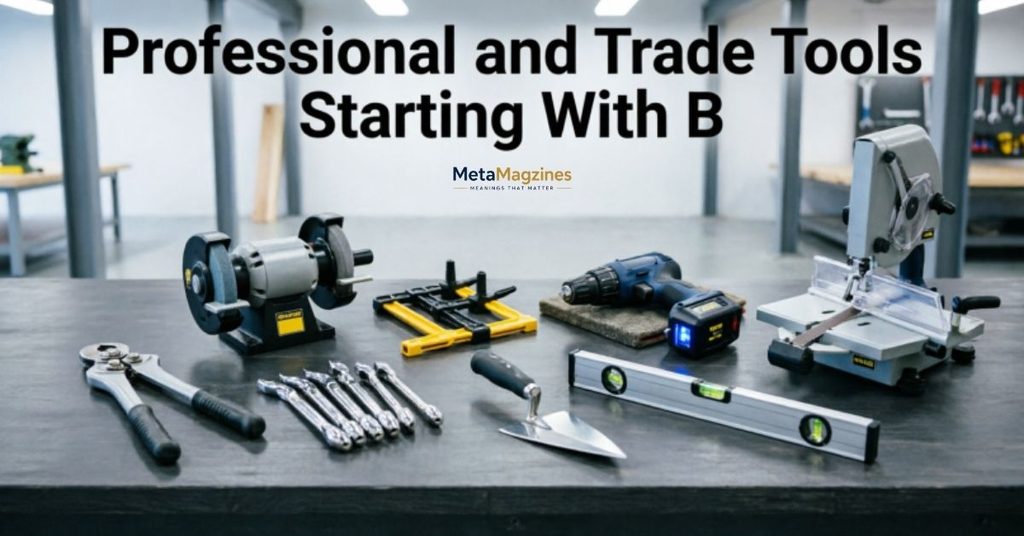
Tools That Start With B are not limited to general workshops; specialized trades use them for leatherwork, printing, bookbinding, metalwork, and butchery.
Bodkin
Type: Trade tool — Leatherwork and bookbinding. A bodkin is a blunt or pointed needle-like tool used to pierce material and guide cord or thread. Its shape makes it useful when fingers alone cannot position the material accurately.
Bookbinding Awl
Type: Trade tool — Bookbinding. A bookbinding awl creates controlled holes through paper, signatures, and boards. A fine point helps produce clean stitch paths without unnecessarily enlarging the opening.
Brayer
Type: Trade tool — Printmaking. A brayer is a roller used to distribute ink over a printing surface. Consistent pressure and a clean roller help produce an even ink layer.
Burnishing Tool (Leather)
Type: Trade tool — Leatherwork. A leather burnisher smooths and compresses exposed edges through controlled friction. The result can make an edge look cleaner and feel more finished.
Blow Torch
Type: Trade tool — Heat application. A blow torch produces a concentrated flame for suitable heating tasks such as soldering or heat-shrink work. Fuel type, flame temperature, ventilation, and fire safety must match the application.
Bench Shear
Type: Trade tool — Sheet-metal cutting. A bench shear uses a lever and fixed cutting geometry to make controlled cuts in sheet material. It is useful when straight cuts are needed without the roughness associated with some powered methods.
Boning Knife
Type: Trade tool — Butchery. A boning knife has a narrow blade intended for separating meat from bone. Blade stiffness and flexibility vary according to the cutting style and type of work.
Block Knife (Butcher’s)
Type: Trade tool — Butchery. A block knife is a substantial knife used for cutting and portioning meat on a work surface. Safe handling requires a stable cutting area and appropriate sharpening practices.
Bookbinder’s Bone Folder
Type: Trade tool — Bookbinding. A bone folder or similar smooth folder helps crease, fold, and score paper without tearing it. Plastic versions are also common where a non-bone material is preferred.
Bench Shears
Type: Trade tool — Metalworking. Bench shears are compact cutting tools mounted or supported for repeated sheet-metal work. They can improve consistency when multiple pieces need similar straight cuts.
Brass Brush
Type: Trade tool — Cleaning. A brass-bristle brush can clean suitable metal surfaces while being less aggressive than some steel brushes. It is useful for removing light residue without unnecessarily scratching compatible materials.
Digital and Software Tools That Start With B
Tools That Start With B can also be digital, covering development, design, analytics, collaboration, testing, and workflow management.
| Tool | Type | Used For |
| Bitbucket | Version control | Code repository and team collaboration |
| Balsamiq | UI design | Wireframing and mockups |
| Buffer | Marketing | Social media scheduling |
| BambooHR | HR software | Employee records and management |
| Basecamp | Project management | Team task and communication hub |
| BrowserStack | Testing | Cross-browser and cross-device testing |
| BigQuery | Data analytics | Large-scale data querying |
| Blender | 3D design | Modeling, animation, and rendering |
| Buildkite | DevOps | CI/CD pipeline automation |
| Beacon | Analytics | User behavior and heatmap tracking |
| Bugsnag | Software monitoring | Error and crash reporting |
| Babel | Development tooling | JavaScript transformation and compatibility |
| Backblaze | Cloud storage | Backup and data storage |
| Bootstrap | Web development | Responsive interface components |
| Brave | Web browser | Privacy-focused web browsing |
These digital products show that a tool does not have to be made of steel to be useful. A developer may use a repository platform, a designer may use a wireframing application, and a marketing team may use a scheduling service as part of the same daily workflow.
When choosing software, look beyond the name. Consider integration, permissions, pricing, export options, learning curve, reliability, and whether the product fits the team’s existing workflow.
Specialized Industrial Tools That Start With B
Tools That Start With B extend into industrial production, where equipment is selected according to capacity, duty cycle, accuracy, and material.
Boring Mill
Type: Industrial tool — Machining. A boring mill enlarges or finishes existing holes in large workpieces. It is used where accurate internal dimensions are required on substantial components.
Band Sealer
Type: Industrial tool — Packaging. A band sealer closes compatible bags by applying heat as the package moves through a sealing system. Production settings benefit from repeatable temperature, speed, and pressure.
Bending Brake
Type: Industrial tool — Fabrication. A bending brake forms sheet metal along controlled lines. It is widely associated with ductwork, panels, flashing, enclosures, and other fabricated parts.
Blasting Cabinet
Type: Industrial tool — Surface preparation. A blasting cabinet encloses abrasive blasting so a part can be cleaned or prepared under controlled conditions. Proper media selection and dust management are important.
Balancing Machine
Type: Industrial tool — Quality control. A balancing machine detects uneven mass distribution in rotating components. Correcting imbalance can reduce vibration and improve the service life of compatible equipment.
Bar Straightener
Type: Industrial tool — Material preparation. A bar straightener passes stock through controlled rollers to reduce bends before further processing. Straight material is easier to machine, measure, and fabricate consistently.
Briquette Press
Type: Industrial tool — Waste management. A briquette press compresses suitable waste streams into denser forms. Depending on the material and system, the output can simplify handling, storage, transport, or approved fuel use.
Bottle Jack
Type: Industrial tool — Lifting. A bottle jack uses hydraulic pressure to lift heavy loads through a compact vertical design. Capacity, base stability, lifting height, and safe support methods must be checked before use.
Broaching Machine
Type: Industrial tool — Machining. A broaching machine pulls or pushes a toothed broach through a workpiece to create precise profiles. It is particularly useful for repeated internal keyways, splines, and other shapes.
Band Saw (Industrial)
Type: Industrial tool — Cutting. An industrial band saw handles large metal stock, billets, pipes, and structural sections. Blade pitch, feed rate, coolant, and material type all affect cutting performance.
Beam Drill Line

Tools That Start With B reach structural fabrication too, where automated drilling equipment can improve repeatability across many steel components.
Type: Industrial tool — Structural fabrication. A beam drill line automates drilling and related preparation on structural steel. It improves repeatability when large quantities of beams or sections require consistent hole patterns.
Bulk Material Feeder
Type: Industrial equipment — Material handling. A bulk feeder meters material into a production process at a controlled rate. Consistent feeding can help downstream equipment maintain stable throughput.
Bolt-Making Machine
Type: Industrial machine — Fastener production. Bolt-making equipment forms or processes fasteners through dedicated production stages. Such machines are designed for repeatability rather than occasional workshop use.
Safety Tools and Equipment Starting With B
Tools That Start With B include safety equipment whose suitability depends on the hazard, certification, fit, and working environment.
Bump Cap
Type: Safety equipment — Head protection. A bump cap offers limited protection from minor knocks in low-risk environments. It should not be substituted for a certified industrial hard hat where falling-object protection is required.
Blast Shield
Type: Safety equipment — Explosion protection. A blast shield places a protective barrier between personnel and a potential pressure or fragment hazard. The shield must be appropriate for the specific risk rather than selected only by appearance.
Breathing Apparatus (SCBA)
Type: Safety equipment — Respiratory protection. Self-contained breathing apparatus supplies breathable air from a cylinder and is used in environments where ordinary filtering respirators are insufficient. Training, inspection, fit, and emergency procedures are essential.
Body Harness
Type: Safety equipment — Fall protection. A full-body harness connects a worker to a compatible fall-arrest or restraint system. Correct fit and approved attachment points are crucial because the harness is one part of a complete protection system.
Barrier Tape
Type: Safety equipment — Hazard marking. Barrier tape visually marks an area that people should not enter. It communicates a boundary but should not be treated as a physical barrier where stronger access control is required.
Boot Guards (Metatarsal)
Type: Safety equipment — Foot protection. Metatarsal guards protect the upper foot from suitable impact and compression hazards. They can be integrated into footwear or used as compatible external protection.
Back Support Belt
Type: Safety equipment — Ergonomic support. A back support belt may provide a sense of support during certain tasks, but it should never replace safe lifting methods, appropriate equipment, or workplace controls.
Barricade (Portable)
Type: Safety equipment — Traffic control. Portable barricades create a visible boundary around work zones, hazards, or restricted areas. High-visibility design and stable placement improve their effectiveness.
Baffle
Type: Safety equipment — Hazard control. A baffle can help redirect or reduce the movement of air, sound, fluid, or particles depending on the system. Its safety value depends entirely on its engineered purpose.
Battery Fire Blanket
Type: Safety equipment — Emergency response. A fire blanket designed for a particular battery hazard is intended as part of a broader emergency plan. Users should follow local fire guidance and the product’s instructions rather than improvising with unsuitable materials.
How to Choose the Right B Tool
Tools That Start With B should be chosen according to the actual job rather than alphabetic appeal or the number of features on a package.
A few practical points before buying:
- Hand tools — Check grip comfort, balance, jaw condition, and intended material. A comfortable tool is easier to control during repetitive work.
- Power tools — Match power rating, speed, battery platform, and accessory compatibility to the material and workload.
- Measuring tools — Choose accuracy based on the tolerance of the job. A basic level is enough for some household work, while precision machining demands more capable instruments.
- Automotive tools — Confirm vehicle compatibility before buying specialty service equipment. A tool that fits one suspension or brake design may not fit another.
- Construction tools — Consider the substrate, job scale, portability, and site conditions. Heavy equipment is not automatically better for every task.
- Woodworking tools — Match the cutting geometry to the grain and operation. Sharp blades and stable workholding often matter more than simply buying a larger machine.
- Safety equipment — Treat certification, fit, inspection, and compatibility as essential requirements rather than optional features.
- Industrial tools — Review capacity, duty cycle, maintenance requirements, operator training, and available service support before committing to equipment.
- Digital tools — Compare integrations, permissions, data handling, user limits, and export options alongside headline features.
- Budget planning — Buy for the work you actually perform. An inexpensive tool used correctly can be more useful than an advanced tool that never leaves the shelf.
Beginner Tips for B Tools
Tools That Start With B are easier for beginners to learn when each item is practiced on the right material under controlled conditions.
- Belt sanders remove material fast, so practice on scrap and keep the machine moving to avoid creating deep grooves.
- Bar clamps should apply balanced pressure; excessive force can bow panels or damage delicate surfaces.
- Bench grinders create sparks and fragments, so keep guards correctly positioned and use suitable eye protection.
- Bolt cutters work most effectively within their rated capacity; placing the material near the intended cutting zone improves leverage.
- Brad nailers can mark or split thin trim when pressure, depth, or angle is wrong, so test the setup before working on visible pieces.
- Block planes reward a sharp blade and light passes. Trying to remove too much material in one cut can cause tear-out.
- Bubble levels should be checked periodically against a known reference because a damaged or misaligned vial can produce misleading results.
- Breaker bars should be used with compatible sockets and controlled body positioning. Do not extend a handle with an improvised pipe unless the tool manufacturer permits that practice.
- Borescopes are most useful when the camera lens is kept clean and the operator records what was observed before disassembly.
- Brushless drills still need the correct bit, speed, clutch setting, and battery for the material; motor technology does not eliminate basic technique.
Read also:
100+ Tools That Start With A: Hand, Power, Mechanic Tools
100+ Tools That Start With C: Hand, Power, Mechanic & Construction Tools
Tools that start with A
The alphabetical idea is useful because readers often compare neighboring letters when building vocabulary lists. Tools That Start With B can be viewed alongside A tools to make it easier to recognize names, functions, and workshop categories.
A broader alphabetical reference can also help students, writers, and quiz participants identify unfamiliar equipment without needing to know a specialist trade in advance. The important part is connecting the name with a practical purpose.
Tools Beginning with C
Comparing letter-based lists can reveal how many different kinds of equipment exist across construction, maintenance, woodworking, and manufacturing. Tools That Start With B provide a useful example because the letter includes both simple hand tools and sophisticated industrial machines.
When building a reference library, keep the same useful fields for every letter: tool name, type, main function, common workplace, and a short safety note. That format makes alphabetical research easier to scan and update.
Tools that start with
An unfinished alphabetical heading can still represent a useful category when readers are searching for names rather than a single trade. Tools That Start With B include familiar household items as well as specialized equipment that beginners may encounter in professional settings.
For practical learning, group names by function after collecting them alphabetically. Cutting, measuring, fastening, shaping, lifting, inspection, and safety are often more useful groupings when someone needs to choose an actual tool.
Tools That Start With aw
Search phrases sometimes contain incomplete or unusual letter combinations, so readers may arrive with a spelling variation rather than a formal tool category. Tools That Start With B are easier to understand when each entry includes a plain-language description.
If a tool name is unfamiliar, check the material it works on, the action it performs, and the setting where it is normally used. Those three clues can often distinguish similar-sounding equipment.
Tools that start with D
Alphabetical tool research can be expanded into a full A-to-Z reference for education, content planning, and workshop vocabulary. Tools That Start With B provide a useful example because they span workshop, automotive, construction, industrial, safety, and digital applications.
A consistent format also helps prevent duplicate entries when the same object has regional names or trade-specific terminology. Recording alternate names separately can make the final glossary clearer.
Tools beginning With ca
Some search queries combine a letter with a partial word, which can create a different intent from a standard alphabetical list. Tools That Start With B still benefit from a clear structure because readers may be looking for a quick answer, a buying idea, or a definition.
A strong reference should prioritize recognizable names first and place specialized equipment later. That gives beginners an accessible entry point without excluding professional terminology.
Tools that start with
Tools That Start With B can also be organized as a quick-reference vocabulary exercise for readers who want short definitions. The same names can then be revisited by trade, material, or function when deeper research is needed.
A duplicate alphabetical heading may appear in a source navigation list, but the useful content remains the same: identify the tool, explain its purpose, and show the context in which it is normally used. That approach keeps the reference practical.
Tools That start with P
A complete tool vocabulary can eventually cover every letter, with each section organized by the same categories. Tools That Start With B work especially well as a standalone guide because they span workshop, automotive, construction, industrial, safety, and digital applications.
Readers can use an alphabetical guide for discovery, then switch to function-based research when they are ready to buy or use an item. That two-stage approach keeps the list informative without turning it into a shopping catalog.
FAQs about Tools That Start With B
What are 100 tools every man needs?
There is no universal set of 100 tools that every person needs. A practical collection usually begins with versatile hand tools, measuring equipment, basic fastening tools, a few cutting tools, and safety equipment, then grows according to the work you actually perform.
What are the 50 tools everyone needs?
Most people do not need the same 50 tools. A sensible starter set can include a hammer, screwdrivers, pliers, adjustable wrench, socket set, utility knife, tape measure, level, drill, clamps, hex keys, and protective equipment, with specialty items added when a specific project requires them.
Can you give me 10 examples of equipment tools?
Ten examples include a bench grinder, bandsaw, belt sander, drill press, bottle jack, boring mill, balancing machine, blasting cabinet, band sealer, and broaching machine. Each belongs to a different use case, so the best choice depends on the material and operation.
Can you give me a list of 50 tools and their uses?
Yes. A useful list should pair each name with a short purpose statement so readers can distinguish similar items. For example, a breaker bar provides leverage for loosening fasteners, a bore gauge measures internal dimensions, a bar clamp holds a workpiece, and a bevel gauge transfers an angle.
What are 20 types of hand tools?
Twenty examples are ball-peen hammer, box-end wrench, brace, bradawl, burnisher, bar clamp, bench plane, block plane, bevel gauge, box cutter, bench hook, bolster chisel, brick bolster, bench vise, bolt cutter, burr tool, brick chisel, battery brush, brass brush, and bench shear. Their functions range from striking and cutting to measuring, clamping, shaping, and cleaning.
Conclusion Tools That Start With B are most useful when the name, function, limitations, and safe operating method are understood together. Learning the names and uses of these tools can turn an alphabetical exercise into practical tool knowledge.
Whether you are organizing a home workshop, maintaining a vehicle, learning carpentry, working on masonry, exploring manufacturing, or choosing software for a team, the right tool is the one that fits the job. Good selection, careful handling, regular maintenance, and appropriate safety practices make tools more useful and more dependable.

