
Science classes are full of terms that look intimidating, but many of them follow patterns you can learn once and reuse. This guide lists more than 120 science words that start with the letter N, grouped by subject and level. Each word comes with a plain-English meaning, so you can use the list for homework, revision, quizzes, or vocabulary practice.
20 Most-Used Science Words That Start With N
These words appear most often in textbooks, exams, and classroom discussion. Learn these first, and the rest of the list will feel easier.
| Word | Field | Simple Meaning |
| Neutron | Physics | An uncharged particle found in the nucleus of most atoms. |
| Nucleus | Physics, Biology | The central core of an atom, or the compartment in a cell that holds DNA. |
| Nutrient | Biology | A substance an organism needs to grow, repair itself, and stay healthy. |
| Natural selection | Biology | The process by which inherited traits that improve survival become more common over generations. |
| Neuron | Biology | A nerve cell that carries electrical and chemical signals. |
| Nitrogen | Chemistry | A gaseous element with the symbol N and atomic number 7. |
| Nebula | Astronomy | A cloud of gas and dust in space, often where new stars form. |
| Nucleotide | Biology | The building block of DNA and RNA, made of a sugar, a phosphate group, and a nitrogen base. |
| Nuclear fusion | Physics | The joining of light nuclei into a heavier nucleus, releasing energy. |
| Nuclear fission | Physics | The splitting of a heavy nucleus into smaller nuclei, releasing energy. |
| Neutrino | Physics | A tiny, nearly massless particle with no electric charge that interacts very weakly with matter. |
| Nova | Astronomy | A sudden brightening of a white dwarf star that occurs in a close pair with another star. |
| Neutralization | Chemistry | A reaction between an acid and a base that produces water and a salt. |
| Nerve | Biology | A bundle of neuron fibers that carries signals between the brain or spinal cord and the body. |
| Nectar | Biology | A sugary liquid that flowers produce to attract pollinators. |
| Niche | Biology | The role an organism plays in its ecosystem, including its habitat, food, and interactions. |
| Nitrate | Chemistry | A compound containing one nitrogen and three oxygen atoms, written NO₃⁻, that plants use as a nitrogen source. |
| Noble gas | Chemistry | A Group 18 element, such as neon or argon, that rarely reacts with other elements. |
| Nonmetal | Chemistry | An element that is usually a poor conductor of heat and electricity and tends to gain electrons. |
| Newton | Physics | The SI unit of force, equal to the force that accelerates a 1-kilogram mass by 1 meter per second squared. |
Physics Science Words That Start With N
Physics terms describe matter, energy, forces, and motion. Many N-words in this field relate to the atomic nucleus or to forces acting on objects.
- Nucleon: A proton or a neutron, the two particles that make up an atomic nucleus.
- Nuclear force: The strong force that holds nucleons together inside a nucleus.
- Net force: The overall force on an object after all individual forces are added together, including direction.
- Normal force: The support force a surface exerts on an object, always pushing perpendicular to the surface.
- Neutron star: An extremely dense remnant left after a massive star collapses, made mostly of neutrons.
- Node: A point on a standing wave where the displacement is always zero.
- Natural frequency: The frequency at which an object vibrates when it is disturbed and then allowed to move freely.
- Neutral (electric charge): A state in which an object has equal amounts of positive and negative charge, so its net charge is zero.
- Nuclear decay: The spontaneous transformation of an unstable nucleus into a more stable one, often releasing radiation.
- Nonconservative force: A force, such as friction, for which the work done depends on the path taken and mechanical energy is not fully conserved.
Chemistry Science Words That Start With N
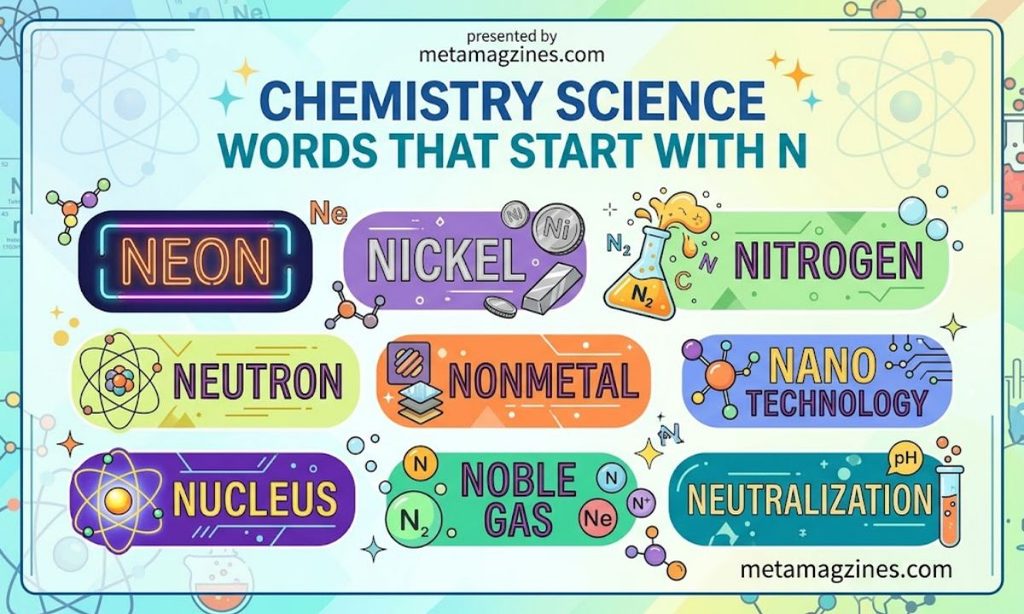
Chemistry vocabulary describes elements, compounds, and reactions. Many N-words here are element names, which are easy to memorize once you see the pattern.
- Nitric acid: A strong acid with the formula HNO₃, used in fertilizer and explosives manufacturing.
- Nitrite: A compound containing one nitrogen and two oxygen atoms, written NO₂⁻.
- Nucleophile: An electron-rich species that donates a pair of electrons to form a new chemical bond.
- Nickel: A silvery transition metal with the symbol Ni and atomic number 28.
- Neon: A noble gas with the symbol Ne that glows reddish-orange when electricity passes through it.
- Neodymium: A rare earth element with the symbol Nd, used to make very strong magnets.
- Neptunium: A radioactive element with the symbol Np and atomic number 93.
- Niobium: A metallic element with the symbol Nb and atomic number 41.
- Nonpolar: Describes a molecule or bond in which electrons are shared evenly, so no side has a partial charge.
- Nuclide: A specific type of atomic nucleus, defined by its number of protons and neutrons.
Biology Science Words That Start With N
Biology terms describe living things, from single cells to entire ecosystems. Learning cell parts and processes with N-words will help you in genetics, anatomy, and ecology units.
- Nucleolus: A structure inside the cell nucleus where ribosomal RNA is made and ribosome parts are assembled.
- Nucleic acid: A large molecule, such as DNA or RNA, that stores and transmits genetic information.
- Nematode: A roundworm with an unsegmented body, found in soil, water, and inside other organisms.
- Notochord: A flexible rod that runs along the back of an embryo and supports the body in chordates.
- Neurotransmitter: A chemical messenger that carries a signal across the gap between two nerve cells.
- Nephron: The microscopic filtering unit of the kidney that removes waste from blood and produces urine.
- Nocturnal: Describes an animal that is active at night and rests during the day.
- Native species: A species that occurs naturally in a particular region without human introduction.
- Neutrophil: A type of white blood cell that is the first responder to bacterial infection.
Earth Science Words That Start With N
Earth science covers the atmosphere, oceans, rocks, and the processes that shape the planet. These terms often appear in weather, geology, and environmental science lessons.
- Nimbus: A dark, rain-producing cloud, or the root word for several cloud names, such as cumulonimbus.
- Nimbostratus: A thick, gray, low-level cloud layer that typically brings steady, widespread precipitation.
- Normal fault: A break in rock where the upper block slides down relative to the lower block.
- Nappe: A large sheet of rock that has been pushed horizontally over other rock layers during mountain building.
- Neap tide: A weak tide that occurs when the Sun and Moon pull at right angles to each other, typically during quarter moons.
- Nunatak: A rocky peak that sticks out through an ice sheet or glacier.
- Neritic zone: The ocean area over the continental shelf, from the shoreline to about 200 meters deep.
- Nekton: Free-swimming aquatic organisms, such as fish and squid, that can move independently of ocean currents.
- Nonrenewable resource: A natural resource, such as coal or oil, that cannot be replaced at a rate fast enough to keep up with use.
- Nitrogen cycle: The movement of nitrogen through the air, soil, water, and living organisms.
- Nutrient cycle: The continuous movement of nutrients between living things and the environment.
- Natural hazard: A natural event, such as an earthquake, flood, or landslide, that threatens people or property.
- Nucleation: The first step in forming a new phase, such as water droplets forming a cloud or crystals forming in a solution.
- Nickel-iron core: The dense, metal-rich center of Earth, which is mostly made of iron with some nickel.
Space & Astronomy Science Words That Start With N
Astronomy terms describe stars, planets, and the structure of the universe. This group includes both familiar words, such as Neptune, and technical words used in research.
- Nebular hypothesis: The leading model explaining how the Sun and planets formed from a rotating cloud of gas and dust.
- Nucleosynthesis: The process that creates atomic nuclei from protons and neutrons, occurring in stars and during the early universe.
- Nadir: The point in the sky directly below an observer, opposite the zenith.
- Neptune: The eighth planet from the Sun and the most distant of the giant planets.
- New Moon: The phase when the Moon sits between Earth and the Sun, so its illuminated side faces away from Earth.
- North celestial pole: The point in the sky that Earth’s rotation axis points toward in the Northern Hemisphere.
- Nutation: A slow, small wobble in the orientation of a rotating body’s axis, such as Earth’s axis.
- Near-Earth object: An asteroid or comet whose orbit brings it close to Earth’s orbit.
- Nearside: The half of the Moon that always faces Earth.
- Newtonian telescope: A reflecting telescope that uses a curved mirror and a flat mirror, invented by Isaac Newton.
Medical & Health Science Words That Start With N
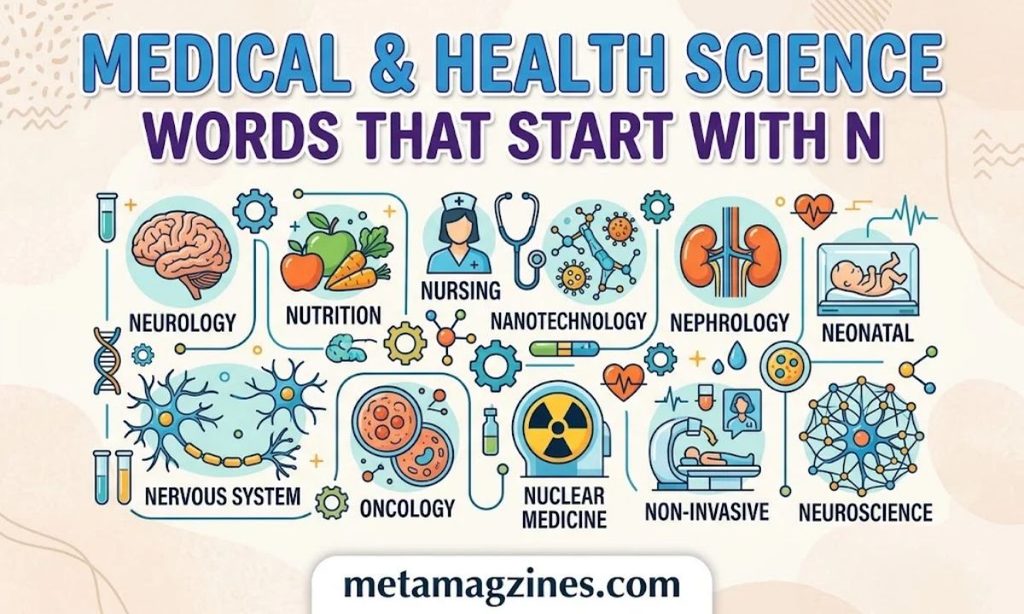
Medical terms describe the body, diseases, and treatments. Many of these words are built from Greek or Latin roots, so learning the roots helps you guess meanings.
- Nausea: An unpleasant feeling in the stomach that often comes before vomiting.
- Neuropathy: Damage to the nerves, often causing pain, numbness, or weakness in the affected area.
- Neuralgia: Sharp, shooting pain that follows the path of a nerve.
- Nephritis: Inflammation of the kidneys.
- Nephrology: The branch of medicine that studies and treats kidney disease.
- Neonatal: Relating to a newborn baby, usually during the first 28 days after birth.
- Nebulizer: A device that turns liquid medicine into a fine mist that a patient inhales.
- Nasal: Relating to the nose.
- Neurotoxin: A substance that damages or destroys nerve tissue.
- Necrosis: The death of body tissue caused by injury, lack of blood supply, or disease.
- Neoplasm: An abnormal new growth of tissue, which can be benign or malignant.
- Nocturia: The need to wake up at night to urinate.
- Nosocomial infection: An infection a patient acquires during a stay in a hospital or other healthcare facility.
- Nicotine: An addictive stimulant found in tobacco plants.
- Nitrous oxide: A colorless gas used as a mild anesthetic, sometimes called laughing gas, in dentistry and surgery.
Technology & Applied Science Words That Start With N
Applied science connects scientific principles to tools, materials, and everyday technology. These terms are common in engineering, computing, and energy topics.
- Nanotechnology: The design and use of materials and devices at the nanoscale, where features measure about 1 to 100 nanometers.
- Nanometer: One billionth of a meter, the unit used to measure very small structures.
- Nanoparticle: A particle between 1 and 100 nanometers in size, used in medicine, electronics, and coatings.
- Nanomaterial: A material with at least one dimension in the nanoscale range.
- Nanosensor: A very small sensor that detects chemical, biological, or physical changes.
- Neural network: A computing model loosely inspired by connections between neurons in the brain, used in artificial intelligence.
- Nuclear reactor: A device that controls a nuclear fission chain reaction to produce heat.
- Nuclear power: Electricity generated from heat released by nuclear reactions.
- Nuclear magnetic resonance: A technique that uses magnetic fields and radio waves to study molecular structure, and the basis of MRI scanning.
- Nickel-metal hydride battery: A rechargeable battery that uses nickel and a metal hydride to store energy.
- Nylon: A synthetic polymer, or polyamide, that is strong and used in fabrics, ropes, and plastics.
- Night-vision device: A tool that amplifies low light or detects infrared radiation to help people see in darkness.
Easy Science Words That Start With N (Great for Younger Students)
These words suit elementary and early middle school learners. They help children connect science to things they see every day.
- Nature: Everything in the physical world that exists without human creation.
- Nest: A structure that birds or other animals build to hold their eggs or young.
- Nose: The body part used for smelling and breathing.
- North: One of the four main compass directions, opposite south.
- Night: The part of the day when the Sun is below the horizon and the sky is dark.
- Nut: A hard-shelled seed or fruit, such as an almond or walnut.
- Nourish: To provide food that helps living things grow and stay healthy.
- Noise: A loud or unwanted sound.
- Neck: The part of the body that connects the head to the shoulders.
- Nail: The hard, protective covering at the tip of a finger or toe.
- Nap: A short period of sleep taken during the day.
Advanced Science Words That Start With N (High School and Beyond)
These terms appear in university courses and advanced high school classes. Each one has a precise meaning, so check the definition in your textbook before using it in an essay or exam.
- Nonlinear dynamics: The study of systems in which a small change in input can produce a disproportionately large change in output.
- Neurogenesis: The formation of new neurons, which occurs mainly during development and in limited regions of the adult brain.
- Neuroplasticity: The brain’s ability to reorganize its connections in response to learning, experience, or injury.
- Nonsynonymous substitution: A DNA mutation that changes the amino acid a codon encodes.
- Nondisjunction: The failure of chromosomes to separate correctly during cell division, which can lead to an abnormal chromosome number.
- Neutrino oscillation: The process by which a neutrino changes from one type, or flavor, into another as it travels.
- Nucleophilic substitution: A reaction in which a nucleophile replaces another group attached to a carbon atom.
- Nonequilibrium thermodynamics: The branch of thermodynamics that describes systems not at equilibrium, which is the case for most real-world processes.
- Nonspontaneous process: A process that does not occur on its own and requires an outside energy input.
- Nonparametric statistics: Statistical methods that make few assumptions about the shape of the data’s distribution.
- Normalization: The process of adjusting values to a common scale, used in data analysis, chemistry, and database design.
Complete Reference List: 100+ Science Words That Start With N
Use this alphabetical list as a checklist for revision. Words that appear in an earlier section are included once here.
Natural frequency, native species, nebula, nebular hypothesis, nebulizer, necrosis, neap tide, nekton, nematode, neodymium, neon, neoplasm, neonatal, neptunium, Neptune, nerve, nervous system terms such as neuron, neurogenesis, neurology, neuropathy, neuralgia, neuroplasticity, neurotoxin, neurotransmitter, neutralization, neutrino, neutrino oscillation, neutron, neutron star, neutrophil, New Moon, newton, nickel, nickel-iron core, nickel-metal hydride battery, niche, niobium, nimbostratus, nimbus, nitrate, nitric acid, nitrite, nitrogen, nitrogen cycle, nitrous oxide, nocturia, nocturnal, node, noble gas, nonconservative force, nondisjunction, nonequilibrium thermodynamics, nonlinear dynamics, nonmetal, nonparametric statistics, nonpolar, nonrenewable resource, nonspontaneous process, nonsynonymous substitution, normal fault, normal force, normalization, nosocomial infection, notochord, nova, nourish, noise, north celestial pole, nuclear decay, nuclear force, nuclear fission, nuclear fusion, nuclear magnetic resonance, nuclear power, nuclear reactor, nucleation, nucleic acid, nucleolus, nucleon, nucleophile, nucleophilic substitution, nucleosynthesis, nucleotide, nucleus, nuclide, nunatak, nutation, nutrient, nutrient cycle, nutrition, nylon, nadir, nail, nap, nasal, natal, nanoparticle, nanomaterial, nanometer, nanosensor, nanotechnology, nature, nausea, Near-Earth object, nearside, neck, nectar, nephritis, nephrology, nephron, nest, net force, neural network, neutral, Newtonian telescope, night, night-vision device, nickel, nicotine, nimbus, nose, north, nuclear, nut, nutrition.
Note that a few entries in that paragraph are broader categories or repeats. Treat the sections above as the authoritative definitions.
Read More: PWMP Meaning: What It Means in Text, TikTok, Snapchat & More
Common Confusions
Many students mix up N-words that sound alike or sit close together in the same unit. The table below clears up the most frequent mix-ups.
| Often Confused | Key Difference |
| Nucleus (atom) vs. nucleus (cell) | The atomic nucleus holds protons and neutrons, while the cell nucleus holds DNA and controls cell activity. |
| Nucleus vs. nucleolus | The nucleolus is a smaller structure inside the cell nucleus that builds ribosome parts. |
| Neuron vs. nerve | A neuron is a single nerve cell, while a nerve is a bundle of many neuron fibers. |
| Neutron vs. neutrino | A neutron is a heavy particle inside atomic nuclei, while a neutrino is a nearly massless particle that barely interacts with matter. |
| Nuclear fusion vs. nuclear fission | Fusion joins nuclei together, and fission splits them apart; both release energy. |
| Nebula vs. nova | A nebula is a cloud of gas and dust, while a nova is a sudden brightening of a white dwarf star. |
| Nitrate vs. nitrite | Nitrate contains three oxygen atoms (NO₃⁻), and nitrite contains two (NO₂⁻). |
| Nucleotide vs. nucleic acid | A nucleotide is a single building block, and a nucleic acid is a long chain of nucleotides. |
| Nutrient vs. nutrition | A nutrient is a specific substance the body needs, and nutrition is the overall process of taking in and using nutrients. |
| Natural selection vs. evolution | Natural selection is one mechanism of evolution, while evolution is the broader change in inherited traits across generations. |
FAQs
1. Which science words starting with N should I learn first?
Start with the 20 most-used words, including neutron, nucleus, nutrient, neuron, nitrogen, and natural selection. These appear in most middle school and high school science courses, so they give you the widest coverage.
2. How can I remember science vocabulary easily?
Group words by topic and learn their root parts, such as “neuro” for nerve or “nucleo” for core. Write a short definition in your own words and test yourself with flashcards every few days.
3. Are these words useful outside school?
Yes, several appear in everyday life and news coverage, including nitrogen in fertilizers, nanotechnology in electronics, nuclear power in energy debates, and nicotine in health discussions. Medical terms such as nausea and nocturia also appear in routine health conversations.
4. What’s the difference between simple and advanced science terms?
Simple terms describe familiar objects or ideas, such as nest or north, while advanced terms describe precise processes or measurements, such as nucleophilic substitution. Advanced words usually need a textbook definition and examples before you can apply them correctly.
5. How many words should I learn at one time?
Learn 5 to 10 new words per study session, and review them over the following week. Spacing your practice this way improves long-term memory better than memorizing a long list in one sitting.
Conclusion
Science vocabulary becomes manageable when you learn it in small, connected groups. Begin with the 20 most-used N-words, then move through the subject sections that match your current class. Use the common confusions table to avoid the mix-ups that cost students marks, and use the complete reference list to check your progress. With steady practice, words like nucleotide, nebula, and nonpolar will become part of your everyday vocabulary.

