
Learning scientific vocabulary becomes much easier when related terms are grouped by subject. This guide brings together useful M words from physics, chemistry, biology, Earth science, astronomy, medicine, technology, and everyday science.
The goal is simple: give students, parents, teachers, and curious readers clear meanings without unnecessary jargon. You can use the list for homework, vocabulary practice, revision, or a quick reference when a difficult term appears in a textbook.
Science words that start with m with meaning
A useful way to study Science Words That Start With M is to connect each word with a familiar idea. Mass relates to matter, momentum relates to motion, and a molecule is built from atoms.
Here are some especially useful examples:
- Mass : the amount of matter in an object.
- Matter : anything that has mass and occupies space.
- Molecule : two or more atoms joined by chemical bonds.
- Magnet : an object that produces a magnetic effect.
- Membrane : a thin boundary that separates one region from another.
- Metamorphosis : a major change in an animal’s body during development.
- Mitosis : cell division that produces two genetically similar cells.
- Microorganism : an organism too small to see clearly without magnification.
- Mutation : a change in DNA.
- Mineral : a naturally occurring inorganic solid with an ordered composition.
- Momentum : the product of mass and velocity.
- Motion : a change in position over time.
- Microscope : an instrument used to enlarge very small objects.
- Melting Point : the temperature at which a solid changes into a liquid.
- Mixture : substances combined without necessarily forming a new chemical substance.
- Moon : a natural satellite.
- Meteorite : a space rock that reaches a planetary surface.
- Myelin : an insulating covering around many nerve fibers.
- Mutualism : an interaction in which both participating species benefit.
- Mantle : Earth’s thick layer between the crust and core.
These basic Science Words That Start With M also provide useful links between subjects. Mass is important in physics and chemistry, while membrane, mitosis, mutation, and microorganism are especially important in biology.
Science words that start with m for kids
For younger learners, Science Words That Start With M are easiest to remember when each definition uses an everyday example. A magnet can pick up some metal objects, a microscope helps us see tiny structures, and a moon can be observed in the night sky.
Some friendly beginner terms include:
| Word | Simple meaning |
| Magnet | An object that attracts certain metals |
| Matter | Anything that takes up space |
| Melt | To change from solid to liquid |
| Moss | A small plant-like organism that often grows in damp places |
| Mold | A type of fungus |
| Migration | Movement of animals from one place to another |
| Muscle | Body tissue that helps produce movement |
| Moisture | Water present in air or on a surface |
| Mammal | An animal whose young are nourished with milk |
| Mineral | A naturally occurring substance found in Earth |
Science Words That Start With M 6th grade
Students in 6th grade often encounter Science Words That Start With M in several different units. Mass and motion appear in physical science, mixtures and molecules appear in chemistry, while minerals and metamorphic rocks appear in Earth science.
A good strategy is to learn the definition first and then attach a concrete example. For instance, momentum describes moving matter, a mineral has characteristic properties, and metamorphosis describes a developmental transformation.
Science words that start with A
Although this guide concentrates on M vocabulary, comparing letters can make science vocabulary easier to organize. A words include atom, acceleration, adaptation, atmosphere, acid, amphibian, astronomy, and energy-related terms beginning with other letters.
When studying Science Words That Start With M, alphabetic comparison is useful because scientific dictionaries and classroom glossaries frequently arrange terms this way. It also makes an A-to-Z revision notebook easier to maintain.
Space words that start with m
Astronomy contains many memorable Science Words That Start With M. The Moon is Earth’s natural satellite, Mars is the fourth planet from the Sun, and the Milky Way is the galaxy containing our Solar System.
Other important terms include meteor, meteorite, magnetosphere, Main Sequence, Mercury, micrometeorite, magnetar, and multiverse. These words describe objects, stellar stages, planetary environments, particles, and theoretical ideas.
Science words that start with S
Science vocabulary beginning with S includes substance, solution, star, sound, spectrum, species, sediment, satellite, photosynthesis-related concepts, and many other terms. Comparing S and M lists can help students see how scientific vocabulary spans different subjects.
For example, Science Words That Start With M include matter and molecule, while S vocabulary may include solution and substance. Linking neighboring concepts is more useful than memorizing isolated definitions.
Space words that start with N
Some astronomy and space terms beginning with N include nebula, neutron star, nova, nuclear fusion, and near-Earth object. These terms cover stars, stellar remnants, reactions, and objects whose orbits bring them relatively close to Earth.
The comparison also shows why vocabulary should be learned by concept. A neutron star connects to gravity and dense matter, while a nebula connects to stars and interstellar material. This approach makes large science word lists easier to understand.
20 Most-Used Science Words Starting With M
The following core terms are among the most useful Science Words That Start With M for general science study.
- Mass : a measure of the amount of matter in an object.
- Matter : physical substance with mass and volume.
- Molecule : a chemically bonded group of atoms.
- Magnet : an object capable of producing a magnetic field.
- Membrane : a selective boundary around a cell or structure.
- Metamorphosis : a substantial developmental change.
- Mitosis : a form of cell division.
- Microorganism : a microscopic organism.
- Mutation : a change in genetic material.
- Mineral : a naturally occurring inorganic solid.
- Momentum : mass multiplied by velocity.
- Motion : movement or change of position.
- Microscope : a device for magnifying small specimens.
- Melting Point : the temperature at which melting occurs.
- Mixture : a physical combination of substances.
- Moon : a natural satellite.
- Meteorite : extraterrestrial material that reaches the ground.
- Myelin : insulating material surrounding many nerve fibers.
- Mutualism : a relationship benefiting both partners.
- Mantle : the thick geological layer below Earth’s crust.
Physics Science Words That Start With M
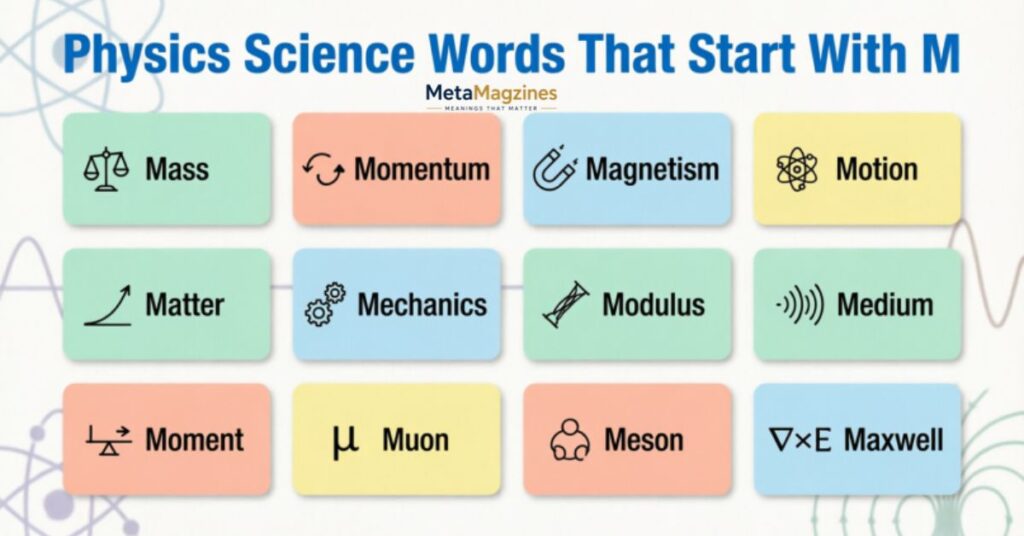
Physics uses Science Words That Start With M to describe matter, forces, movement, waves, materials, and fields.
- Mass : Mass measures inertia and helps determine how an object responds to force.
- Motion : Motion describes changing position and can be analyzed through displacement, speed, and velocity.
- Momentum : Momentum depends on mass and velocity. A heavier object moving at the same velocity generally carries more momentum.
- Magnetic Field : A Magnetic Field describes the region in which magnetic effects can influence other magnetic materials or moving electric charges.
- Magnetism : Magnetism is associated with moving charges and magnetic moments.
- Mechanical Energy : Mechanical Energy includes energy associated with movement and position.
- Melting Point : Melting Point is a characteristic temperature useful for identifying materials.
- Medium : A Medium is the material through which many waves propagate. Sound, for example, requires a material medium.
- Mirror : A Mirror reflects light and can form different types of images.
- Modulus : Modulus describes a material’s response to deformation and is important when discussing elasticity and stiffness.
- Velocity : Velocity describes speed together with direction.
- Force : Force can change an object’s motion.
- Gravity : Gravity attracts masses toward one another.
- Wave : A Wave transfers energy and information without necessarily transporting matter from one location to another.
- Light : Light is electromagnetic radiation.
- Sound : Sound is a mechanical wave requiring a medium.
- Energy : Energy is the capacity to produce change.
- Elasticity : Elasticity describes a material’s ability to return toward its original form.
- Stiffness : Stiffness measures resistance to deformation.
- Pendulum : A Pendulum provides a classic example of periodic motion.
- Magnetic Force : Magnetic Force acts between magnets, magnetic materials, and moving charges.
- Electric Charges : Electric Charges create electric fields and interact through electromagnetic forces.
Mass, momentum, motion, velocity, force, and energy are closely connected. Magnetic Field, Magnetism, Magnetic Force, and Electric Charges belong to another important physics cluster.
Chemistry Science Words That Start With M
Chemistry contains many Science Words That Start With M because M words describe particles, quantities, materials, reactions, and solutions.
- Molecule : A Molecule contains atoms joined through chemical bonds.
- Mixture : A Mixture contains multiple substances without requiring them to become one new chemical substance.
- Mole : A Mole is a counting unit used for extremely large numbers of particles.
- Molarity : Molarity expresses the amount of solute in a specified volume of solution.
- Metal : A Metal commonly conducts heat and electricity and may display characteristic luster and malleability.
- Metalloid : A Metalloid has properties intermediate between typical metals and nonmetals.
- Monomer : A Monomer is a relatively small molecular unit that can join to form a polymer.
- Malleability : Malleability describes the ability of a material to be shaped without breaking.
- Mass Number : Mass Number equals the number of protons plus neutrons in an atom’s nucleus.
- Miscible : Miscible liquids mix completely in suitable proportions.
- Monoatomic : Monoatomic describes a substance whose particles exist as individual atoms.
- Molecular Formula : A Molecular Formula indicates which atoms and how many of each occur in a molecule.
- Atom : An Atom contains a nucleus surrounded by electrons.
- Proton : A Proton carries positive electric charge.
- Neutron : A Neutron has no net electric charge.
- Nucleus : The Nucleus contains most of an atom’s mass.
- Polymer : A Polymer consists of repeated molecular units.
- Chemical Bond : A Chemical Bond holds atoms together.
- Solution : A Solution is a homogeneous mixture.
- Concentration : Concentration indicates how much solute is present relative to a specified amount of solution or solvent.
- Glucose : Glucose is a simple sugar important in cellular energy metabolism.
- Carbon : Carbon forms the backbone of countless organic molecules.
- Hydrogen : Hydrogen is the lightest chemical element.
- Oxygen : Oxygen is essential for many biological and combustion processes.
- Silicon : Silicon is a metalloid widely used in electronics.
- Iron : Iron is an important metal in industry and biology.
- Copper : Copper is a highly useful electrical conductor.
- Gold : Gold is a relatively unreactive metal.
- Helium : Helium is a noble gas.
- Water : Water is a polar compound essential for life.
- Alcohol : Alcohols are organic compounds containing a hydroxyl group.
- Salt : Many salts consist of positively and negatively charged ions.
Mole, Molarity, Molar Mass, Molecule, Molecular Formula, Monomer, Polymer, and Chemical Bond form a useful chemistry vocabulary chain.
Biology Science Words That Start With M
Biology provides some of the most recognizable Science Words That Start With M.
- Mitosis : cell division used in growth and tissue maintenance.
- Meiosis : specialized division that produces reproductive cells.
- Membrane : a selective cellular boundary.
- Mitochondria : organelles involved in cellular energy production.
- Microorganism : a microscopic organism.
- Metamorphosis : developmental transformation.
- Mutualism : an interaction benefiting both organisms.
- Mutation : a change in DNA.
- Mycelium : the network of fungal filaments.
- Myelin : insulation around many nerve fibers.
- Muscle Tissue : tissue specialized for contraction.
- Multicellular : consisting of many cells.
- Monocot : a flowering plant group characterized by one cotyledon.
- Morphology : the study of biological form and structure.
- Mutagenesis : the generation of genetic mutations.
Meiosis differs from mitosis because it reduces chromosome number and contributes to genetic variation. Mutation can also contribute to variation, while DNA carries hereditary information.
Mitochondria, mitochondrial DNA, mitochondrial matrix, membrane, cell, chromosome, and energy are connected through cellular biology. Myelin, motor neuron, nerve fibers, and nerve signals connect to nervous-system function.
Mycelium and mycorrhizae demonstrate another useful relationship. Fungi form extensive networks, and mycorrhizal associations can help plant roots obtain water and nutrients.
Earth Science Words That Start With M
Earth science includes Science Words That Start With M describing rocks, landforms, atmosphere, rivers, glaciers, tectonics, and natural events.
- Mantle : Earth’s thick layer between crust and core.
- Mineral : a naturally occurring inorganic solid.
- Magma : molten rock beneath Earth’s surface.
- Metamorphic Rock : rock altered by heat, pressure, or chemically active fluids.
- Moraine : sediment and rock debris deposited by glaciers.
- Monsoon : a seasonal atmospheric circulation pattern.
- Mesosphere : an atmospheric layer above the stratosphere.
- Meander : a winding bend in a river.
- Mid-Ocean Ridge : an underwater mountain system associated with seafloor spreading.
- Magnitude : a numerical measure used in several scientific contexts, including earthquake size.
- Earth : the planet on which we live.
- Crust : Earth’s outer solid rocky layer.
- Core : Earth’s innermost major layer.
- Rock : a naturally occurring aggregate of minerals or mineraloids.
- Lava : molten rock reaching the surface.
- Limestone : a sedimentary rock rich in calcium carbonate.
- Slate : a fine-grained metamorphic rock.
- Shale : a layered sedimentary rock.
- Glacier : a persistent mass of flowing ice.
- Volcano : an opening or structure through which magma and volcanic materials reach the surface.
- Tectonic Plates : large moving sections of Earth’s lithosphere.
- Ocean Floor : the bottom of an ocean basin.
- Sediment : particles deposited by water, wind, ice, or gravity.
- River : flowing surface water occupying a channel.
- Atmosphere : the gaseous envelope around a planet.
- Stratosphere : an atmospheric layer above the troposphere.
- Earthquake : sudden ground shaking caused by energy release in Earth’s interior.
- Richter Scale : a historical logarithmic scale associated with earthquake magnitude.
Magma, mantle, lava, volcano, tectonic plates, mineral, metamorphic rock, and sediment form a particularly useful Earth science vocabulary group.
Space & Astronomy Science Words That Start With M

Astronomy has a rich collection of Science Words That Start With M.
- Moon : Earth’s natural satellite.
- Mars : the fourth planet from the Sun.
- Milky Way : the galaxy containing our Solar System.
- Meteor : the visible streak created when a space object interacts with an atmosphere.
- Magnetosphere : a region dominated by a planet’s magnetic influence.
- Main Sequence : the long-lived stellar stage during which stars fuse hydrogen in their cores.
- Mercury : the innermost planet in our Solar System.
- Micrometeorite : a very small meteorite.
- Multiverse : a speculative framework involving multiple universes.
- Planet : a large celestial body orbiting a star.
- Galaxy : a gravitationally bound system containing stars and other matter.
- Star : a luminous sphere of plasma powered primarily by nuclear processes.
- Sun : the star at the center of our planetary system.
- Hydrogen : the main fuel involved in hydrogen fusion in ordinary main-sequence stars.
- Helium : a major product of hydrogen fusion.
- Solar Wind : a stream of charged particles flowing outward from the Sun.
- Magnetic Shield : an informal description of protective magnetic influence.
- Cosmic Rays : high-energy particles arriving from space.
- Atmosphere : a gaseous layer surrounding a planetary body.
- Neutron Star : an extremely dense stellar remnant.
- Universe : the totality of known space, time, matter, and energy.
Meteor, meteorite, micrometeorite, Moon, Mars, Mercury, Milky Way, magnetosphere, Main Sequence, and multiverse illustrate how one letter can cover planetary science, stellar science, and cosmology.
Medical & Health Science Words That Start With M
Medical vocabulary also contains many Science Words That Start With M.
- Metabolism : the network of chemical processes occurring in living organisms.
- Malignant : describing cancerous growth capable of invasion or spread.
- Mucus : a protective secretion produced by mucous membranes.
- Myocardium : the muscular tissue of the heart.
- Malaria : an infectious disease caused by parasites transmitted by certain mosquitoes.
- Meningitis : inflammation involving the protective membranes around the brain and spinal cord.
- MRI : magnetic resonance imaging, a method for producing detailed internal images.
- Macrophage : an immune cell that engulfs particles and cellular debris.
- Malnourishment : inadequate intake or absorption of needed nutrients.
- Motor Neuron : a neuron that transmits signals involved in muscle movement.
- Cancer Cells : cells that have acquired abnormal growth characteristics.
- Heart Muscle : muscle tissue responsible for pumping blood.
- Brain : the central organ of the nervous system.
- Spinal Cord : a major pathway connecting the brain with the body.
- Magnetic Fields : fields used in several medical and scientific technologies.
- Radio Waves : electromagnetic waves used by some imaging and communication systems.
- Immune Cells : cells involved in defense against pathogens and abnormal material.
- Bacteria : single-celled organisms with enormous biological diversity.
- Parasite : an organism that obtains resources from a host.
- Mosquitoes : insects capable of transmitting several pathogens.
- Nutrients : substances needed for growth, maintenance, and normal biological function.
- Nerve Signals : electrical and chemical messages transmitted by the nervous system.
- Blood Supply : circulation delivering oxygen and nutrients to tissues.
Metabolism connects nutrients to chemical reactions and energy. MRI uses magnetic fields and radio waves rather than ionizing radiation, while macrophages form part of the immune system.
Read More: 95+ Science Words That Start With G | Full List with Meanings
Technology & Applied Science Words That Start With M
Modern technology provides another group of useful Science Words That Start With M.
- Microprocessor : an integrated circuit that performs computational operations.
- Module : a self-contained component within a larger system.
- Modulation : changing a carrier signal to encode information.
- Machine Learning : computational methods that identify patterns in data.
- Mechanical Advantage : the benefit a machine provides by changing force or movement.
- Magnetic Resonance : a physical phenomenon used in magnetic resonance technologies.
- Computer : an electronic system that processes information.
- Electronic Devices : systems using electronic components to perform functions.
- Spacecraft : vehicles designed for operation beyond Earth’s atmosphere.
- Software : instructions that direct computer hardware.
- Code : structured instructions used by computers.
- Radio : technology for transmitting or receiving electromagnetic signals.
- AM : amplitude modulation.
- FM : frequency modulation.
- Wave : a propagating disturbance or oscillation.
- Engineering : application of scientific and mathematical knowledge to practical problems.
- Simple Machines : devices that make force application more convenient.
- Lever : a rigid bar rotating around a fulcrum.
- Pulley : a wheel-and-rope arrangement used to redirect or multiply force.
- Ramp : an inclined plane.
- Proton : a positively charged subatomic particle.
- Fusion Energy : energy associated with nuclear fusion.
- Plasma : an ionized state of matter containing charged particles.
Machine Learning can identify patterns in large datasets. Modulation makes radio communication possible, while mechanical advantage explains why a lever, pulley, or ramp can make a physical task easier.
Easy Science Words That Start With M : Beginners & Kids
For beginners, Science Words That Start With M should be learned through familiar objects and actions.
| Word | Simple Meaning | Example |
| Magnet | Attracts certain materials | A magnet can attract iron |
| Matter | Physical substance | Water is matter |
| Melt | Become liquid through heating | Ice can melt |
| Moss | Small green plant-like organism | Moss grows on damp surfaces |
| Mold | A type of fungus | Mold can grow on old food |
| Migration | Movement from one area to another | Birds migrate seasonally |
| Muscle | Tissue that produces force | Muscles move the body |
| Moisture | Water in or on something | Soil contains moisture |
| Mammal | Animal that feeds young with milk | A whale is a mammal |
| Iron | A common metal | Iron is used to make steel |
| Steel | Iron-based alloy | Steel is used in buildings |
| Air | Mixture of gases | We breathe air |
| Water | Essential chemical compound | Plants need water |
| Fungus | Organism group including molds and mushrooms | Yeast is a fungus |
| Seasons | Recurring periods associated with Earth’s orbit and tilt | Winter and summer are seasons |
| Animal | Multicellular organism in the animal kingdom | A dog is an animal |
| Plant | Organism that generally performs photosynthesis | A tree is a plant |
| Milk | Nutrient-rich biological fluid produced by mammals | Mammals feed young with milk |
These examples make Science Words That Start With M easier to remember because each definition has a concrete connection. Children can also draw a magnet, Moon, mammal, molecule, muscle, and microscope to reinforce the vocabulary.
Advanced Science Words That Start With M
Advanced Science Words That Start With M are useful for high-school, university, and specialist study.
- Meiotic Division : the stages of meiosis that produce cells with reduced chromosome number.
- Molecular Orbital Theory : a model describing molecular electrons as occupying orbitals associated with the molecule.
- Magnetohydrodynamics : the study of electrically conducting fluids interacting with magnetic fields.
- Morphogenesis : the biological development of form and structure.
- Mycorrhizae : associations between fungi and plant roots.
- Muon : a fundamental particle related to the electron but much heavier.
- Mesophyll : internal leaf tissue containing many photosynthetic cells.
- Metallurgy : the science and technology of metals.
- Mitochondrial DNA : DNA located in mitochondria.
- Macroevolution : evolutionary change occurring at or above the species level.
Molecular Orbital Theory connects molecules, atoms, electrons, and chemical bonding. Magnetohydrodynamics connects magnetic fields with conducting fluids such as plasma and has applications in fusion research.
Morphogenesis concerns how biological form develops, while mycorrhizae connect fungi, roots, plants, and nutrients. Mitochondrial DNA is useful in evolutionary studies, ancestry research, and some forensic applications.
Complete Reference List : 170+ Science Words That Start With M
Below is an expanded reference list of M vocabulary. The entries are deliberately concise so students can scan the list quickly.
| Science word | Meaning |
| Macroevolution | Evolutionary change above the population level |
| Macronutrient | Nutrient required in relatively large quantities |
| Macrophage | Immune cell that engulfs particles |
| Magma | Molten rock below Earth’s surface |
| Magnet | Object producing magnetic effects |
| Magnetic Field | Region influenced by magnetic forces |
| Magnetic Declination | Difference between geographic and magnetic north |
| Magnetism | Phenomena associated with magnetic effects |
| Magnetohydrodynamics | Study of conducting fluids and magnetic fields |
| Magnetosphere | Region dominated by a planetary magnetic field |
| Magnetar | Highly magnetized neutron star |
| Magnitude | Numerical measure of size or strength |
| Main Sequence | Hydrogen-fusing stage of stellar evolution |
| Malaria | Parasitic infectious disease |
| Malignant | Cancerous and potentially invasive |
| Malleability | Ability to deform under compression |
| Malnourishment | Inadequate nutritional condition |
| Mammal | Milk-producing vertebrate animal |
| Mangrove | Salt-tolerant coastal plant community |
| Mantle | Thick layer between crust and core |
| Mars | Fourth planet from the Sun |
| Mass | Amount of matter |
| Mass Extinction | Large-scale loss of species |
| Mass Number | Protons plus neutrons |
| Matter | Substance with mass and volume |
| Meander | Winding river bend |
| Mechanical Advantage | Force multiplication by a machine |
| Mechanical Energy | Energy associated with movement or position |
| Medium | Material through which a wave travels |
| Meiosis | Specialized reproductive cell division |
| Meiotic Division | Division stages associated with meiosis |
| Melanin | Biological pigment |
| Melting | Solid-to-liquid phase change |
| Melting Point | Temperature at which a substance melts |
| Membrane | Selective biological boundary |
| Meningitis | Inflammation around the brain and spinal cord |
| Meniscus | Curved liquid surface |
| Mercury (element) | Chemical element Hg |
| Mercury (planet) | Planet closest to the Sun |
| Mesoderm | Middle embryonic germ layer |
| Mesophyll | Internal leaf tissue |
| Mesosphere | Atmospheric layer above the stratosphere |
| Metabolism | Chemical processes sustaining life |
| Metal | Element with characteristic metallic properties |
| Metalloid | Element with mixed metal/nonmetal behavior |
| Metallurgy | Study and processing of metals |
| Metamorphic Rock | Rock changed by heat or pressure |
| Metamorphosis | Major developmental transformation |
| Meteor | Visible atmospheric streak from a space object |
| Meteorite | Space material reaching the ground |
| Meteorology | Study of weather |
| Methane | CH4 hydrocarbon gas |
| Microchip | Small electronic circuit |
| Microclimate | Localized climate conditions |
| Microevolution | Small-scale genetic change |
| Microhabitat | Small ecological living area |
| Micrometeorite | Tiny meteorite |
| Microbiome | Community of microorganisms |
| Microgravity | Very weak apparent gravity |
| Micron | One millionth of a meter |
| Microorganism | Microscopic organism |
| Microprocessor | Central processing component |
| Microscope | Instrument for magnification |
| Mid-Ocean Ridge | Underwater mountain chain |
| Midbrain | Brain region involved in several functions |
| Migration | Movement between locations |
| Milky Way | Galaxy containing the Solar System |
| Millibar | Unit of pressure |
| Mineral | Naturally occurring inorganic solid |
| Mineral Cycle | Movement of minerals through environments |
| Mirror | Reflective surface |
| Miscible | Capable of mixing completely |
| Mitochondria | Organelles involved in energy metabolism |
| Mitochondrial DNA | DNA located in mitochondria |
| Mitochondrial Matrix | Internal compartment of mitochondria |
| Mitosis | Division producing two similar daughter cells |
| Mixture | Physical combination of substances |
| Mobile Phase | Moving phase in chromatography |
| Modulation | Alteration of a signal to carry information |
| Module | Independent component of a larger system |
| Modulus | Measure related to material deformation |
| Moist | Slightly wet |
| Molarity | Moles per volume of solution |
| Molar Mass | Mass of one mole |
| Mole | Chemical counting unit |
| Molecular Formula | Formula showing atomic composition |
| Molecular Orbital Theory | Theory describing molecular electron orbitals |
| Molecule | Group of chemically bonded atoms |
| Mollusca | Animal phylum including snails and octopuses |
| Molten | Liquefied by heat |
| Momentum | Mass multiplied by velocity |
| Monoatomic | Existing as individual atoms |
| Monocot | Flowering plant with one cotyledon |
| Monocular | Using one eye or lens |
| Monomer | Building unit of a polymer |
| Monsoon | Seasonal wind and rainfall system |
| Moon | Natural satellite |
| Moon Phases | Apparent changing illuminated shapes of the Moon |
| Moraine | Glacially deposited debris |
| Morbidity | Condition or rate associated with disease |
| Morphogenesis | Development of biological form |
| Morphology | Study of form and structure |
| Mortality | Death occurrence within a population |
| Motility | Ability to move independently |
| Motion | Change in position |
| Motor Neuron | Neuron involved in muscle control |
| MRI | Magnetic resonance imaging |
| MRSA | Antibiotic-resistant Staphylococcus aureus |
| Mucilage | Thick plant secretion |
| Mucosa | Mucus-producing body lining |
| Mucus | Protective biological secretion |
| Muon | Heavy elementary particle related to the electron |
| Multicellular | Composed of many cells |
| Multiverse | Hypothetical collection of universes |
| Muscle Tissue | Contractile animal tissue |
| Mutagenesis | Process producing mutations |
| Mutation | Change in genetic material |
| Mutualism | Relationship benefiting both organisms |
| Mycelium | Network of fungal filaments |
| Mycorrhizae | Fungal-root association |
| Myelin | Insulating nerve covering |
| Myocardium | Heart muscle |
| Myofibril | Contractile structure within muscle cells |
| Myopia | Nearsightedness |
| Myosin | Protein involved in muscle contraction |
Common Confusions : M Words People Mix Up
Mitosis and meiosis are related but not interchangeable. Mitosis generally produces two daughter cells with the same chromosome number as the parent cell, whereas meiosis involves specialized divisions that reduce chromosome number and generate reproductive cells.
Magma and lava describe molten rock in different locations. Magma is beneath the surface, while lava is molten rock that has erupted onto the surface.
Mass and weight are also different. Mass describes the amount of matter, while weight is the gravitational force acting on that mass. An object’s mass does not change simply because it moves from Earth to the Moon.
Meteor, meteoroid, and meteorite describe different stages or contexts. A meteoroid is a space object, a meteor is the visible atmospheric phenomenon, and a meteorite is material that survives to reach the ground.
A mixture is not the same as a compound. Components of a mixture retain their individual chemical identities, while a compound contains elements chemically bonded in a defined arrangement.
Mutualism differs from commensalism and parasitism. In mutualism both partners benefit; in commensalism one benefits while the other is generally unaffected; in parasitism one benefits at the expense of another.
Where M Science Words Show Up in Real Life
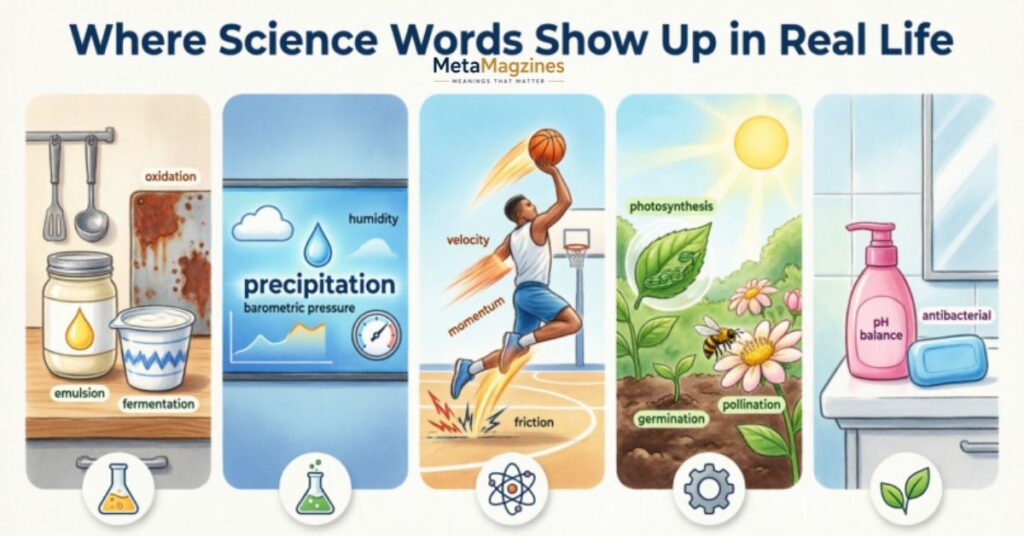
Science Words That Start With M appear in everyday activities more often than many people realize.
At the doctor’s office, patients may encounter MRI, metabolism, myocardium, mucus, malignant, macrophage, meningitis, motor neuron, and medical terms related to membranes and muscles.
In the kitchen, melting point helps explain why butter and chocolate soften, mixtures appear in sauces and drinks, microorganisms help produce fermented foods, and mold can develop when food is stored improperly.
Outside, mineral describes materials in rocks, migration describes seasonal animal movement, moisture describes water in the environment, and microclimate describes small-scale differences in local conditions.
In weather and Earth science, monsoon, meteorology, mantle, magma, mineral, meander, moraine, and magnitude can appear in forecasts, documentaries, textbooks, and news reports.
In space news, Moon, Mars, meteor, meteorite, magnetosphere, solar wind, cosmic rays, Mercury, Milky Way, and Main Sequence are common vocabulary.
On a phone or computer, microprocessor, microchip, module, software, code, modulation, Machine Learning, and electronic devices describe technologies that operate behind the screen.
FAQs
What is a science word for m?
There are many useful M terms. Mass, matter, molecule, magnet, membrane, mineral, motion, momentum, mutation, mitosis, microorganism, and metabolism are strong examples. The best choice depends on the science subject being studied.
What are 10 science words?
Ten examples are mass, matter, molecule, magnet, mineral, motion, momentum, mutation, mitosis, and molecule-related terminology. Together they cover physics, chemistry, biology, and Earth science.
What are 50 science words?
A 50-word science vocabulary set can include mass, matter, molecule, magnet, membrane, metamorphosis, mitosis, microorganism, mutation, mineral, momentum, motion, microscope, melting point, mixture, Moon, meteorite, myelin, mutualism, mantle, magnetism, medium, mirror, modulus, mole, molarity, metal, metalloid, monomer, malleability, meiosis, mitochondria, mycelium, morphology, magma, metamorphic rock, moraine, monsoon, mesosphere, meander, Mars, Milky Way, meteor, magnetosphere, Mercury, micrometeorite, metabolism, MRI, macrophage, and motor neuron.
What are some words for science?
Science vocabulary includes terms from many disciplines. Examples include atom, molecule, matter, force, energy, motion, cell, DNA, organism, mineral, planet, galaxy, reaction, solution, evolution, metabolism, microorganism, magnetism, and radiation.
What is science A to Z?
Science A to Z is a way of organizing scientific vocabulary alphabetically. It can include terms from physics, chemistry, biology, Earth science, astronomy, medicine, environmental science, and technology. An alphabetic system makes it easier to find unfamiliar terminology quickly.
Conclusion
Science Words That Start With M cover an unusually broad range of subjects, from mass and motion to molecules, membranes, minerals, mitochondria, meteorites, metabolism, and Machine Learning. Learning the meanings in subject-based groups makes the vocabulary easier to remember.
The most effective approach is to connect each term with an example or related concept. Once mass connects to matter and momentum, or magma connects to mantle and lava, scientific vocabulary becomes a connected system rather than a collection of isolated definitions.

