
If you received “IGU” in a text message, the meaning depends on the conversation around it. In most casual texting, IGU means “I Got You,” a short way to show understanding, agreement, reassurance, or support.
There is another possible reading: “I Give Up.” That version usually appears with frustration, defeat, repeated failure, venting, sarcasm, or dramatic humor. The surrounding message, conversational tone, and texting tone usually make the intended meaning clear.
Start Here: The Two IGU Meanings
The most common IGU meaning is “I Got You.” In texting language, it works as a quick response when someone makes a request, explains a plan, shares a location, or needs backing someone up. It can communicate confirmation without requiring a longer sentence.
The second IGU meaning is “I Give Up.” This reading is less common and usually depends on message context. A frustrated sender may use the abbreviation after repeated failure, while a friend may use it as dry humor or dramatic humor. The mood surrounding the message matters more than the three letters themselves.
In ordinary online communication, IGU can therefore function as either a supportive message or a defeated reaction. This is why the same abbreviation can sound reassuring in one conversation and completely defeated in another.
How to Tell Which One IGU Is
Start with the sentence immediately before the abbreviation. If someone asked for help, confirmation, a favor, or a plan, IGU usually means “I Got You.” That is the normal IGU meaning in texting and chat.
If the sender has been complaining about an essay, math problem, losing a season, or repeated failure, “I Give Up” becomes much more likely. A defeated emoji can make that slang interpretation especially obvious.
The conversational tone is also useful. A supportive message usually has a cooperative texting tone, while the “I Give Up” version often carries frustration, defeat, sarcasm, or humor.
A practical way to read the abbreviation is:
- Request or favor → “I Got You”
- Agreement or confirmation → “I Got You”
- Someone needs support → “I Got You”
- Plan or location → “I Got You”
- Repeated failure → “I Give Up”
- Frustration → “I Give Up”
- Dramatic humor → “I Give Up”
- “💀” or “😭” after a difficult situation → often “I Give Up”
- Obvious sarcasm → check the rest of the message
- No clear context → default to “I Got You”
This approach works across texting abbreviations, text slang, chat slang, internet slang, and social media slang because message context usually carries more information than the abbreviation itself.
Read More: Woot Woot Meaning — Real Explanation Nobody Bothers to Give
IGU Real Examples That Show the Difference
Here are original IGU examples showing how the same three-letter abbreviation can communicate opposite ideas.
“I Got You” examples
Friend: “Can you save a seat for me?”
Reply: “IGU.”
Here, the IGU meaning is clearly supportive. It acts as a casual response meaning “I Got You” or “I’ll take care of it.”
Friend: “I’m running late. Can you tell them I’m on the way?”
Reply: “IGU.”
Again, the abbreviation expresses agreement, confirmation, and backing someone up.
Friend: “I’ll send you the location when I get there.”
Reply: “IGU.”
In this online communication example, IGU is simply a quick response showing understanding.
“I Give Up” examples
Friend: “I have rewritten this essay six times and it still sounds terrible.”
Reply: “IGU.”
Here, the likely meaning is “I Give Up.” The surrounding frustration changes the slang interpretation.
Comment: “Tried this math problem for two hours. IGU 💀”
The defeated emoji strengthens the defeated mood. This is a common pattern in internet slang and social media comments.
Group chat: “Our team lost again. IGU 😭”
The crying emoji and repeated failure point toward “I Give Up,” not “I Got You.”
More situations to consider
- “Can you pick me up?” → likely support
- “I’ll cover your shift.” → likely commitment
- “That’s the plan.” → likely confirmation
- “I cannot solve this anymore.” → likely defeat
- “This game is impossible.” → possibly giving up
- “Fine, IGU, do whatever you want.” → possibly sarcasm
- “IGU 😂” → tone requires context
- “IGU 💀” → often dramatic humor
- “IGU 😭” → often frustration or defeat
- “IGU, seriously.” → usually supportive depending on the preceding message
Does the Sender’s Gender Change the IGU Meaning?

No. The basic IGU meaning does not change simply because the sender is a guy or a girl. Gender and texting slang can influence personal style, but the abbreviation itself still depends primarily on context, tone, and the relationship between sender and receiver.
Someone searching for the IGU meaning from a guy may be trying to determine whether a message has romantic significance. Someone searching for the IGU meaning from a girl may have the same concern. Neither question can be answered from IGU alone.
If an IGU from someone you like follows a request, invitation, or plan, it can reasonably sound positive. However, IGU in relationships should be interpreted through the entire conversation rather than treated as a secret romantic code.
A friend, close friend, person you’re texting, or someone you’re interested in can all use the same abbreviation differently. The safest slang interpretation is based on the request, mood, and conversational tone.
IGU on Snapchat and TikTok
On Snapchat, IGU can work naturally in short Snapchat messages because users often prefer compact texting abbreviations. The IGU meaning on Snapchat is usually “I Got You” when a person is confirming a plan or acknowledging a request.
In Snapchat slang, however, a dramatic message can turn the same abbreviation into “I Give Up.” A sender complaining about homework, dating, a game, or a failed plan may use IGU with a defeated emoji.
TikTok slang follows a similar pattern. In TikTok comments, IGU may communicate agreement with a creator or support for another commenter. In TikTok comments about frustrating situations, the phrase may instead communicate defeat.
Social media comments and social media threads also create unusual context because the sender and receiver may not know each other personally. A short abbreviation can therefore depend heavily on the caption, video, previous comment, and emoji.
In a group chat, the audience changes the texting tone. In a private text, the same phrase can feel more personal. Discord slang can be similarly context-sensitive because a gaming discussion, friend conversation, or community thread may use different forms of chat slang.
IGU vs. Similar Terms
| Term | Common meaning | Typical tone |
| IGU | I Got You / I Give Up | Depends on context |
| I gotchu | I Got You | Warm and casual |
| IGY | I Got You | Short and less common |
| I.G.U. | Usually an abbreviation of the same letters | More formal-looking |
| IGU + 💀 | Often I Give Up | Defeated or humorous |
| IGU + 😭 | Often I Give Up | Frustrated or dramatic |
| I Got You | Clear wording | Supportive |
| I Give Up | Clear wording | Defeated |
“I gotchu” is close to IGU but feels more conversational. IGY can also mean I Got You, although its usage is less universal. These abbreviated phrases should not automatically be treated as interchangeable in every situation.
For slang interpretation, compare the full message rather than the abbreviation alone. A supportive emoji can reinforce an encouraging reading, while a defeated emoji can signal frustration or giving up.
IGU vs I gotchu
“I gotchu” tends to feel warmer and more personal. It often sounds like something a close friend might send during casual texting.
IGU is more compressed. Its texting tone can be neutral, efficient, supportive, sarcastic, or defeated depending on the message context.
IGU vs IGY
IGY is generally easier to interpret because the letters more directly suggest “I Got You.” IGU is more ambiguous because it can also represent “I Give Up.”
That difference makes IGU more dependent on conversational tone and surrounding context.
The Window Industry IGU (Separate Thing Entirely)
There is also a completely different IGU meaning outside texting. In the window industry, IGU stands for “insulating glass unit.”
An insulating glass unit is a sealed glazing assembly containing two or more panes separated by a spacer. Double-pane windows commonly use this construction, while triple-pane windows use three panes.
In glass manufacturing and construction terminology, IGU refers to the physical insulated glass assembly rather than texting language.
The purpose of insulated glass is to improve thermal performance. Depending on the design, glazing can help retain indoor heat during cold conditions and limit unwanted heat transfer when cooling a building.
Therefore, “IGU meaning windows” and “IGU meaning in text” belong to entirely different subjects. One concerns construction terminology and insulated glazing; the other concerns texting abbreviations and chat slang.
How to Reply When Someone Sends You IGU
If the sender means “I Got You,” a simple response is usually best. You can say:
- “Thanks!”
- “Perfect.”
- “Appreciate you.”
- “Awesome, see you then.”
- “That helps a lot.”
- “Thank you for backing me up.”
A quick response is appropriate because IGU itself is already a quick response. There is no need to turn a short confirmation into a formal conversation.
If the sender means “I Give Up,” match the mood instead. A casual response can acknowledge frustration without making the situation unnecessarily serious.
Examples include:
- “Honestly, same 😭”
- “Take a break and try again.”
- “You were so close.”
- “I feel that.”
- “Don’t quit yet.”
- “That problem is cursed 💀”
How to respond to IGU in a relationship
When someone you like sends IGU, do not assume the abbreviation is flirting. Look at the preceding conversation. If they agreed to a date, plan, favor, or request, the message likely signals agreement or commitment.
An IGU response can therefore be warm without being romantic. The receiver should consider relationship history, texting etiquette, and the sender’s normal texting language before reading extra meaning into it.
What Actually Happens in Real Conversations
In real online conversations, abbreviations rarely operate independently. People use text slang to save time, create a particular texting tone, show humor, or signal belonging within a social group.
The most useful rule is simple: read IGU as “I Got You” when the message involves support, agreement, understanding, confirmation, or a request. Read it as “I Give Up” when the conversation centers on frustration, defeat, repeated failure, or giving up.
IGU from a guy
An IGU from a guy does not automatically carry a special meaning. If he responds to a request with IGU, the most likely interpretation is still “I Got You.”
If the message appears after a joke about losing or failing, the likely meaning can switch to “I Give Up.” The surrounding text matters more than gender.
IGU from a girl
The same principle applies to an IGU from a girl. An agreement, plan, favor, or supportive exchange usually points toward “I Got You.”
If the sender is venting or using dramatic humor, the phrase may instead communicate defeat. There is no universal female-specific version of the abbreviation.
IGU from someone you like
An IGU from someone you like can feel more significant because you are naturally paying closer attention to their texting tone. Still, the abbreviation alone does not establish romantic interest.
Look for the larger pattern: whether they initiate conversations, make plans, follow through, ask questions, and communicate consistently. One three-letter abbreviation is weak evidence compared with the overall relationship.
IGU with skull emoji
IGU with skull emoji often signals “I Give Up,” especially when the conversation involves a difficult task, embarrassing event, repeated failure, or absurd situation.
The skull emoji can also represent laughter in internet slang, so message context remains important. A funny story may produce IGU with skull emoji without meaning literal defeat.
IGU with crying emoji

IGU with crying emoji frequently has a defeated or overwhelmed feel. It can mean “I Give Up” after a difficult experience, but it may also be dramatic humor.
If the sender has been venting about work, school, dating, gaming, or another frustrating situation, the crying emoji strengthens the interpretation that they are giving up.
Why context beats the abbreviation
The same IGU can be a supportive message at noon and a defeated joke at midnight. The letters do not change, but the conversation does.
That is why message context, conversational tone, texting tone, mood, sarcasm, and humor should all be considered together.
IGU in casual texting
Casual texting favors compact forms because people often want a quick response rather than a complete sentence. IGU fits that environment well.
This does not mean every sender uses the abbreviation consistently. Texting language varies by age, friendship group, platform, and personal style.
IGU in online communication
Online communication creates many opportunities for ambiguous slang because text lacks vocal tone and facial expression. Emojis, punctuation, previous messages, and timing can provide missing clues.
In social media threads, comment sections, and group chat conversations, the audience also affects how a sender phrases a response.
IGU and texting etiquette
When you are uncertain whether the receiver understands the abbreviation, writing “I Got You” is clearer. This is especially useful in professional messages, first-time conversations, or situations involving unfamiliar people.
Three-letter abbreviations are efficient, but clarity should come before brevity when the stakes are high.
Igu meaning in text what those three letters actually mean tik
The IGU meaning in text on TikTok depends on the content surrounding the comment. TikTok slang often uses abbreviations as quick reactions, and viewers may understand them differently depending on the creator and community.
In a supportive TikTok comments thread, IGU can mean “I Got You.” In a frustrating or comedic post, it can mean “I Give Up.” The video itself often provides the missing context.
A creator discussing an impossible challenge may receive IGU as a humorous defeated reaction. A commenter asking for help may receive IGU as confirmation or support.
Igu meaning text snapchat
The IGU meaning in text on Snapchat is commonly “I Got You” when someone is acknowledging a request, location, plan, or favor. Snapchat messages tend to be short, so texting abbreviations are especially natural there.
Still, Snapchat slang can be playful. If a sender has been complaining about a failed plan or difficult situation, IGU may instead mean “I Give Up.” The preceding Snapchat messages are the best clue.
Igu meaning text from a guy
The IGU meaning text from a guy is not inherently different from the abbreviation used by anyone else. If the conversation concerns a request, agreement, or plan, “I Got You” is the most sensible reading.
If you are wondering whether an IGU from a guy indicates romantic interest, look beyond the abbreviation. A supportive message can show attentiveness without necessarily being flirtatious.
IGU meaning from a girl
The IGU meaning from a girl is likewise determined by context rather than gender. A response to a favor or plan will generally communicate “I Got You.”
If the conversation involves frustration, defeat, or a joke about giving up, “I Give Up” may be intended instead. The sender’s usual texting style can help you make the distinction.
Does IGU mean i got you
Yes, IGU can mean “I Got You,” and that is generally the first interpretation to consider when the surrounding message involves understanding, support, confirmation, agreement, or commitment.
However, IGU can also mean “I Give Up.” This second meaning becomes more plausible when the sender is venting, describing repeated failure, or using dramatic humor.
Igu meaning glass
In glass manufacturing, IGU means “insulating glass unit.” It has nothing to do with text slang.
An insulating glass unit is commonly found in double-pane windows and triple-pane windows. It uses multiple panes and an enclosed space to improve the performance of insulated glazing.
So when someone searches for the IGU meaning in glass or construction, they are asking about a technical term rather than a texting abbreviation.
What does lgu mean in text
“LGU” is not the same as the standard IGU abbreviation. In some messages, a person may simply have mistyped IGU or used a less common abbreviation.
The safest approach is to check the message context. If the conversation clearly points toward “I Got You” or “I Give Up,” the sender may have intended IGU.
What does igy mean in text
IGY commonly represents “I Got You.” It is similar to the supportive use of IGU but is less ambiguous because it does not normally suggest “I Give Up.”
In casual texting, IGY can function as a quick response to a request, plan, or statement requiring confirmation. Like other texting abbreviations, its exact tone depends on the sender.
How to tell what IGU means
Use a five-step method:
- Read the sentence before IGU.
- Identify whether the sender is helping or complaining.
- Look for emojis such as 💀 or 😭.
- Check whether the conversation contains sarcasm or dry humor.
- Consider the relationship and normal texting style.
This method works because slang interpretation depends on context. It also prevents a common mistake: assuming every IGU means the same thing.
IGU response: what should you send back?
For the supportive meaning, keep your IGU response straightforward. “Thanks,” “Perfect,” or “Appreciate it” works well.
For the defeated meaning, acknowledge the mood. A supportive emoji, a joke, or a short encouraging message can fit better than a formal answer.
IGU real examples you can recognize instantly
“Can you bring my charger?” — “IGU.”
Meaning: I Got You.
“Are you coming with us?” — “IGU.”
Meaning: I Got You / yes, understood.
“I have failed this level twelve times. IGU 💀.”
Meaning: I Give Up.
“Another deadline? IGU 😭.”
Meaning: I Give Up.
“You need someone to cover for you? IGU.”
Meaning: I Got You.
“This assignment makes no sense. IGU.”
Meaning: I Give Up.
IGU vs similar terms in everyday texting
The distinction between IGU, IGY, and I gotchu is mostly about familiarity and tone. I gotchu often feels warmer, while IGY is relatively direct.
IGU is the most context-dependent because it can represent two opposite ideas. When the meaning is important, spelling out “I Got You” or “I Give Up” removes ambiguity.
Frequently confused meanings
Some readers confuse IGU with IG, IGS, IGY, or LGU. These abbreviations are not automatically interchangeable.
The safest approach is to interpret each abbreviation according to the exact message, platform, and conversation. Do not assume that a similar-looking three-letter abbreviation has the same meaning.
When IGU sounds supportive
IGU sounds supportive when someone asks for assistance, reassurance, agreement, or confirmation. In those situations, it functions as a compact way to communicate “I Got You.”
It can also signal commitment. If someone says they will save a seat, share a location, cover a task, or help with a plan, IGU can mean they accept the request.
When IGU sounds defeated
IGU sounds defeated when the sender has exhausted their patience or failed repeatedly. “I Give Up” fits conversations involving frustration, defeat, giving up, or venting.
The defeated emoji is a strong clue, although emojis can also be used for humor. Always consider the entire message rather than relying on one symbol.
When IGU is sarcastic
Sarcasm can make IGU deliberately ambiguous. A person may say “IGU” while obviously refusing to cooperate, especially among friends who already understand each other’s humor.
Dry humor and deadpan tone can make this harder to detect. Punctuation, previous messages, and the sender’s normal style help reveal the intended meaning.
IGU and relationships
IGU in relationships is not a secret code with one fixed emotional meaning. It can show support, agreement, reassurance, or simply acknowledgment.
If the message comes from someone you’re interested in, avoid overanalyzing three letters. Consistent behavior, communication, and follow-through provide more useful information about the relationship.
IGU in a group chat
In a group chat, IGU may function as a public confirmation. Everyone can see that the sender has agreed to a plan or offered support.
The same phrase in a private text may feel quieter and more personal. The meaning can remain identical while the social weight changes.
IGU in comment sections
In comment sections, the abbreviation may react to content rather than respond to a direct request. That makes the surrounding post especially important.
A funny fail, impossible challenge, or relatable complaint can make “I Give Up” more likely. A supportive post can make “I Got You” more likely.
IGU and social media slang
Social media slang evolves quickly, and abbreviations can develop different habits across communities. Snapchat slang, TikTok slang, and Discord slang may overlap without being identical.
Because online communication is highly contextual, users should interpret slang through the post, caption, comments, emojis, and conversation history.
IGU as a quick response
One reason IGU works well is efficiency. It compresses a longer supportive sentence into a quick response that fits casual texting.
That efficiency is also the source of ambiguity. A short abbreviation removes grammatical information that would otherwise tell the receiver whether the sender means “I Got You” or “I Give Up.”
IGU and supportive messages
A supportive message can be very short. IGU may reassure a friend that their request has been understood or accepted.
This is especially useful when a person needs backing someone up, encouragement, or confirmation rather than a long explanation.
IGU and frustration
Frustration creates the opposite reading. If a sender has spent hours trying to solve something, IGU can become shorthand for “I Give Up.”
Repeated failure, venting, and defeat are strong contextual signals. Humor can make the statement less literal, especially in social media comments.
IGU and emojis
Emojis frequently provide the emotional information missing from text. A supportive emoji may strengthen the “I Got You” interpretation, while a defeated emoji can push the meaning toward “I Give Up.”
Still, emoji usage varies between people. A skull emoji can mean laughter, while a crying emoji can indicate laughter, sadness, frustration, or exaggeration.
IGU and texting tone
Texting tone is shaped by wording, punctuation, emoji choice, timing, and relationship. IGU by itself has a relatively neutral tone.
The sender can make it warmer through additional words or emojis, or make it more sarcastic through context. This is why conversational tone should always be considered.
IGU and casual texting
Casual texting encourages abbreviated phrases because speed matters. People often remove unnecessary words while retaining enough information for the receiver to understand.
IGU fits this pattern particularly well when both participants already share the same texting language.
IGU and online communication
Digital communication has no physical voice or facial expression, so meaning often has to be inferred. This makes context especially important for abbreviations.
In one-on-one conversation, the receiver can usually rely on previous messages. In public social media threads, the post and comments provide much of the needed context.
IGU and texting etiquette
Good texting etiquette means choosing clarity when ambiguity could create a problem. If you are talking to a new coworker, customer, teacher, or unfamiliar person, writing the full phrase may be preferable.
Among close friends, three-letter abbreviations are usually less risky because both people understand the established texting style.
IGU and digital communication
Digital communication has made abbreviated phrases common across messaging platforms. People use them to save time, express personality, and participate in online communities.
However, abbreviations do not have universal definitions. The receiver should interpret them in context rather than treating an acronym like a dictionary entry with only one possible meaning.
IGU meaning in texting vs. chat
The IGU meaning in texting and the IGU meaning in chat are usually identical. Both environments commonly use IGU for “I Got You.”
The “I Give Up” interpretation can appear in either environment when frustration or humor provides the necessary context.
IGU meaning in text vs. social media
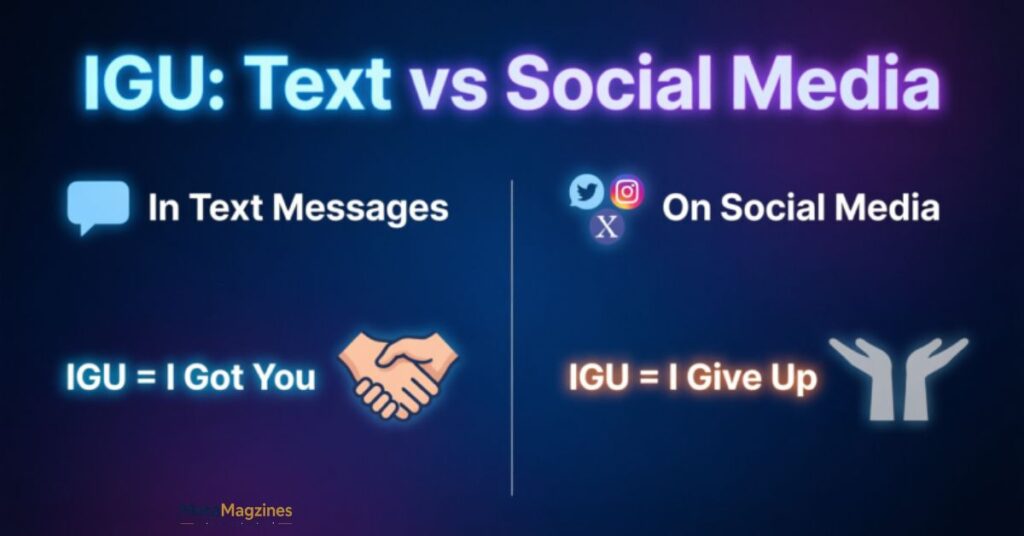
The IGU meaning in text is often easier to interpret because a private conversation supplies more background. Social media posts may provide less direct context.
On TikTok comments, Snapchat messages, social media comments, and comment sections, the content surrounding the abbreviation becomes particularly important.
IGU slang and modern texting language
IGU slang belongs to a broader family of texting abbreviations and internet slang. Its popularity is partly explained by the need for fast, compact communication.
Modern texting language changes continuously, so an abbreviation can become more or less common without receiving a formal announcement. Context remains the most reliable tool.
IGU acronym or abbreviation?
IGU is commonly described as an acronym or abbreviation in casual explanations. Technically, whether a short form qualifies as an acronym depends on how it is formed and pronounced.
In everyday discussion, calling IGU an abbreviation is sufficient. Users searching for IGU meaning in text generally want to know what the letters stand for rather than debate terminology.
Why IGU has two meanings
The two meanings arise from the same initials being mapped to different phrases. “I Got You” and “I Give Up” both produce I-G-U.
Because the phrases have opposite emotional directions, context becomes essential. One expresses support and commitment; the other expresses frustration and defeat.
A simple rule to remember
When someone needs help, read IGU as “I Got You.” When someone has had enough, read IGU as “I Give Up.”
If neither situation is obvious, inspect the previous message, emojis, conversational tone, and sender’s normal texting style before deciding.
FAQs
What does igu mean in text?
IGU most commonly means “I Got You” in text slang. It can express understanding, agreement, confirmation, reassurance, support, or commitment.
In a frustrated conversation, however, IGU can mean “I Give Up.” The message context and texting tone usually reveal which meaning the sender intended.
What does igu mean on TikTok?
On TikTok, IGU can mean “I Got You” when a commenter is agreeing with or supporting someone. It can also mean “I Give Up” under content about failure, difficult challenges, or frustration.
TikTok comments frequently use emojis and humor, so the video and surrounding comments should be considered before interpreting the abbreviation.
What is IG in Gen Z?
IG commonly means “Instagram” in social media conversations, although abbreviations can have different meanings depending on context. It may also appear as a shortened form of other expressions.
Gen Z texting language contains many context-dependent abbreviations, so the surrounding conversation remains important.
What is IG slang in text?
IG slang commonly refers to informal language used in texting and social media. Depending on context, “IG” can refer to Instagram or other shortened expressions.
The broader category includes texting abbreviations, internet slang, chat slang, and social media slang. The intended meaning should be inferred from the message.
What does igs mean in slang?
“IGS” can have multiple interpretations depending on the online community and message context. It should not automatically be treated as one universal slang definition.
When an abbreviation is unfamiliar, checking the surrounding conversation, platform, and tone is more reliable than assuming a single meaning.
Conclusion
The most useful way to understand IGU is to read the conversation around it. In a request, plan, or supportive exchange, it usually means “I Got You”; after frustration or failure, it can mean “I Give Up.”
The abbreviation is simple, but its tone is flexible. Check the message context, emojis, relationship, and texting style before deciding what the sender intended, and when clarity matters, ask rather than guess.

